Category Archives: Essays

The Lamentable State of Mainstream Journalism

<td style='padding:2px 1px 0px 5px;' colspan='2'McChrystal’s Balls – Honorable Discharge
The Daily Show With Jon Stewart Mon – Thurs 11p / 10c
www.thedailyshow.com
Daily Show Full Episodes Political Humor Tea Party

This is a nice job by Jon Stewart highlighting the lamentable state of mainstream political journalism in the U.S. Particularly revealing is the comment by Celeste Headlee where she says to the Rolling Stones journalist who revealed the McChrystal story, “you were obviously not worried about access in the future; I can’t imagine you are going to get it”. In other words, in the mainstream press, you don’t report on unfavorable news, lest you not be given access to the politicians in the future. Welcome to the White House. Easy questions, easy answers, easy access; become one with the propaganda machine.

1 Comment

Filed under Essays, Obama 44

Law & Order and the Republican Mantra

<td style='padding:2px 1px 0px 5px;' colspan='2'Tron Carter’s Law & Order
Chappelle’s Show
www.comedycentral.com
Buy Chappelle’s Show DVDs Black Comedy True Hollywood Story

At the suggestion of ReWrite, here is a video from The Chappelle Show that serves as a good accompaniment to yesterday’s post on the Republicans’ cynical worldview of due process for corporations only.

3 Comments

Filed under Essays

The Republican Mantra Part II: Rights for Corporations Only

It is hard to think of something more cynical than the Republican reaction to President Obama’s deal with BP. Then again, it should have come as no surprise that Republicans have reiterated their official decree on the supremacy of corporations over individuals. Without getting into the merits of Obama’s $20 billion shakedown of BP(to be honest, I haven’t been paying much attention), the Republicans’ outbursts against the Executive Branch strong-arming a corporation completely ignores the reality of the entire American prosecutorial system and how it treats individuals.

As Joe Barton first said (though he later apologized),

I’m ashamed of what happened in the White House yesterday . . . I think it is a tragedy in the first proportion that a private corporation can be subjected to what I would characterize as a shakedown — in this case a $20 billion shakedown — with the attorney general of the United States, who is legitimately conducting a criminal investigation and has every right to do so to protect the American people, participating in what amounts to a $20 billion slush fund that’s unprecedented in our nation’s history, which has no legal standing, which I think sets a terrible precedent for our nation’s future.

Would Mr. Barton feel the same way about prosecutors who every day use the threat of the death penalty, lifetime sentences, three-strikes-you’re-out, and other means of arm-twisting at their disposal to persuade criminal suspects to reach a plea bargain? Prosecutors particularly love the death penalty because it is the most effective negotiating tool they’ve got. So where does Mr. Barton stand on terrible precedents: you plea or I’ll do everything in my power to send you to your death or “show me the money”?

This may sound exaggerated, but this is in fact what people – not corporations – are up against every time they right or wrongly face a prosecutor. Have Republicans ever seen an episode of Law & Order? Remember that prosecutors are agents of the Executive Branch, and as such their decision to prosecute a case is always a political decision; there really isn’t much of difference between Obama’s political tactic and that of your average district attorney. Apparently for Republicans, though, it is only scandalous when the poor, helpless corporation faces the prosecution.

Even though the Republicans feigned disgust at Mr. Barton’s original statement above, they quickly sent their pundits out to regurgitate their talking points about how Obama was ignoring the rule of law, denying BP due process, and of course, setting a dangerous precedent. Ignoring the obvious error in the due process claim (BP very much has the right to contest the “strong arming” in court), the Right’s sudden passion for due process is remarkably cynical.

Tony Blanky on Left, Right and Center was seriously concerned about “protecting the process of law” (even citing Thomas More), and out of the blue, David Brooks on the NewsHour felt that Obama “very brutally strong armed BP” and was worried about “the erosion of the rule of law”. He was so noble to claim that the law was there to protect “even people who do bad things.” Then George Will on This Week compared Obama to Hugo Chavez, calling his actions the “use of raw political power without recourse to courts that exist for this sort of thing without due process . . .”

Must I state the obvious? Misters Blanky, Brooks, and Will are arguing the exact opposite of what they have been fighting for for the past eight years: the president’s unfettered, unchecked power to indefinitely detain terror suspects without due process. If corporations, according to Citizens United, have the same First Amendment rights as individuals, shouldn’t individuals (even the ones “who do bad things”) have, at a minimum, the same basic rights corporations do when it comes to due process in a court that, as Mr. Will says, “exist[s] for this sort of thing”?

For example, would these gentlemen disagree with President Obama’s continued, indefinite detention in cages of Guantanamo detainees without any recourse whatsoever, even when they have been determined – as in the case of Mohamed Hassan Odaini — by the military and the courts to be completely innocent? Or would they continue to aspire to a world where corporations are free from government interference while individuals are subject to the full force of government’s brutal wrath?


5 Comments

Filed under Essays, Obama 44

Because of My Descent

There are always two sides to every story, at least that is what we are supposed to believe. Personally, in this story I have no stake. I am not a Christian or Muslim Arab and I am not a descendant of European or American Jews. As an American – and one who grew up amongst a large Jewish minority outside of Washington, DC, I do have a certain natural affinity for Jewish culture. As a matter of fact, I have probably been to a synagogue (for bar mitzvahs and weddings) more times than I have been in a Christian church of any denomination.

Furthermore, I – with my well-trained American olfactory sense for sniffing political incorrectness and racism – now live in Europe and can attest to the fact that Europe is not an option for Jews. Even more than a half century after the Holocaust, I cannot think of a single European country that is comfortable with sharing its society with a non-indigenous, non-Christian minority. Europeans define themselves as European, not on shared values or citizenship (in a strictly political sense), but on ethnicity alone. Full stop. It shouldn’t be surprising then that while most Europeans would not consider themselves anti-Semitic, the vast majority side with the Palestinians over the Israelis. Ironically, though, Europeans are more openly hostile to Muslims than they are to Jews.

So there you have it: regardless of what Helen Thomas may think, Jews of European descent really don’t have the option of going back to Europe. On the other hand, though, you have all of the Palestinians – both Christians and Muslims – who have spent the last half century asking themselves why they should have to pay the price for the Europeans’ brutality towards the Jews. They’re wondering why an American from New York or a Russian has more rights in and to the land they grew up in than they do. And just as I have grown up with the children of those who were forced to flee for their lives from Europe to the U.S., I also know Palestinians who have lost their family homes, quite literally, to Americans and Europeans resettling in Israel.

So without taking any sides – once again as I have absolutely no stake in the dispute – I read Rabbi David F. Nesenoff’s critique of Helen Thomas in today’s Washington Post. Rabbi Nesenoff happens to be the person to whom Ms. Thomas uttered those very unfortunate words about how the Jews should leave Palestine and return to Europe and America, inevitably causing Thomas to resign her position as a White House journalist.

Interestingly enough, what Rabbi Nesenoff finds most troublesome is that Ms. Thomas justified her comments by declaring that she was “from Arab descent”. (Ms. Thomas’ father was an Arab Christian immigrant to the U.S.)

For the next few paragraphs Rabbi Nesenoff discredits Thomas’ conclusion with a few different predictable arguments about the inherent anti-Semitism in her statement and how it denies a two-state solution to the crisis, and even how the Bible grants this land to the Jews. But in the end, he too denies the other’s right to co-exist, offering little more than the exact mirror of Thomas’ “because I am from Arab desecent”:

My grandmother used to kibitz, “Friends you choose; family you’re stuck with.” The Jew is stuck with Israel. There is no ungluing the connection. It is beyond the ambiguous term “chosen people”; they are “the people who have no choice.” It is more than a religious belief; it is a value and a moral barometer of the Earth. History, truth, integrity and the foundation of our world are not negotiable.

In other words, this land is mine because I am Jewish. And you are not.

At least both of them are comfortable in the U.S., as long as they don’t move to Arizona.

1 Comment

Filed under Essays

On Faith and Patriotism

unamuno.jpg

The main character in Miguel de Unamuno’s San Manuel Bueno, Mártir explains that for him faith is not blindly believing in God, but rather desiring that He exist. In other words, faith is not about accepting God’s existence as a given, but wanting more than anything else that it were true.

I take a similar position on patriotism. I am not one of the tribalists who will blindly and unconditionally support my country/government simply because it is my country. Rather, I believe that we must demand, at all times, that our country meet the expectations we have of it. For at the end of the day, the government is nothing more than the reflection of the people it represents. As such, I believe we should be even stricter in scrutinizing the politicians we vote for than those we do not. For that very reason, for example, I am so critical of the Obama Administration. Precisely because I supported Obama, I am responsible for holding him accountable as my President.

Finally, in Grave Error, I am almost exclusively critical the U.S. and Spain (the two countries where I consider a part of society). For example, I often criticize the U.S. foreign policy toward certain nations, but rarely criticize those nations’ policies toward the U.S. The reason is simple: I am American. I understand my country and feel that as such, I have a right to judge its actions. On the other hand, I know very little about those nations (other than what the tribalistic American press tells me), nor do I vote for their politicians. I am unqualified to speak.

Moreover, just as I cannot stand those non-Americans who freely bash the U.S. government and culture — almost always from the standpoint of ignorance or half-truths – I particularly cautious not to fall into the same easy trap with regards to others. Just as it is dangerous to take the sola fide position — typical of Christian and Muslim fundamentalists — that faith justifies almost anything, patriotism based on pure tribalism leads us no where. True patriotism is about expecting more and accepting less.

5 Comments

Filed under Digressions, Essays

Do the Palestinians Have the Right to Exist?

gaza.jpg

Over the last few days’ media coverage of Israel’s botched interception of the aid flotilla in international waters off the coast of Gaza, I kept hearing cries in the U.S. press – mainly by politicians and right wing pundits — justifying Israel’s actions on the basis that Hamas doesn’t believe Israel has the right to exist. Without any intention of passing judgment whatsoever on Israel, I kept wondering why Hamas’ opinion mattered. First of all, why would anyone even bother to lend credibility to such nonsense unless they purposefully wanted to empower Hamas? Does a farm league baseball team get air-time to question the Yankee’s existence? But more importantly, Israel does exist. It is the region’s only true military super power, backed by the unconditional support of the most expensive, powerful and technologically advanced military the world has ever known. Furthermore, Israel is fully autonomous and frankly couldn’t care less what anyone else thinks (not even the U.S.) about its actions and proceeds accordingly.

But with so much focus on the well-resolved question of Israel’s existence, it surprises me that no one ever asks whether the existence of the Palestinians is at stake. For example, when 89 year-old Helen Thomas is rightfully criticized for her clearly anti-Semitic (and politically ridiculous) comments, shouldn’t logic dictate that comparable anti-Arab statements be followed by similar condemnation?  Why is it that Ms. Thomas resigns while prominent right wing journalists (and politicians) who make anti-Arab statements never meet the same fate? As Glenn Greenwald writes,

As for the Helen Thomas condemnation fest and subsequent resignation today, the central issue — as both my Salon colleague Gabriel Winant and The American Prospect’s Adam Serwer adeptly document — is not the perception that she’s guilty of bigotry, but the wrong kind of bigotry.  Anyone who doubts that should compare the cheap, easy and self-righteous outrage orgy against the powerless, 89-year-old columnist to the total non-reaction in the face of the incessant and ongoing anti-Arab bigotry of The New Republic’s Marty Peretz, or to the demands of then-House Majority Leader Dick Armey that the Palestinians leave the West Bank and go back to where they came from, and similar statements from Mike Huckabee (still gainfully employed at Fox News).

That’s because, as I wrote the last time Peretz had one of his vicious anti-Arab rants, severe punishment is meted out to those who engage in the wrong kind of prejudice while those who spout the right kind do so with total impunity.  That, and the fact that there are consequences for the actions only of the powerless in Washington, but never the powerful.

Not that it should make any real difference, but the standard-issue “they’re Muslims and we are the enlightened West” chauvinistic rationalism doesn’t quite apply. When referring to Arabs, we should understand that the term also includes Christians. As a matter of fact, the Catholic Church just produced a study that found that the Israeli-Palestinian conflict is a key factor in the diminishing presence of Christians in the Middle East. A large chunk of Palestinian Christians have left and those who have remained suffer the same fate as their Muslim compatriots. (Arab Christians are also important minorities in Egypt, Lebanon, Syria, Jordan, and in Iraq until the fall of the Sadam Hussein – ironically, a collateral effect of the U.S. invasion of Iraq was to topple one of the only secular governments in the Middle East with an important Christian political class in government.) The study also made reference to the fundamentalist (and principally American Protestant) Christian belief in the Rapture — that frighteningly quirky belief that Israel must be first cleansed of all non Jews in order to prepare for Jesus’ second coming.

So recognizing the obvious – that Israel’s existence is a given while that of the Palestinians is precarious — and taking into account the ongoing, unrepentant settlements and that Gaza is a virtual prison of 1.5 million people comparable in modern times perhaps only to Soweto, there is one question the righteous should be asking: do the Palestinians have a right to exist?

I think that answering that question in the affirmative and with conviction would resolve much of the problem, including defusing the raison d’être, demagoguery, and feigned outrage of many of the Region’s biggest instigators.

6 Comments

Filed under Essays

On Entitlements and Health Care

public-option.jpg

If Israel is infallible, can’t do no wrongno questions asked — and has universal public health care, shouldn’t we, the American tax payers who so graciously shell out billions a year in our hard earned money to subsidize Israel, also get a public option?

On another note, if it is unconstitutional under the Establishment Clause of the First Amendment for public money to flow to domestic religious groups, how does sending billions a year in tax payer money to self-defined religious states pass constitutional muster?

2 Comments

Filed under Essays

Extraordinarily Hypocritical or Extraordinarily Ordinary: Obama’s Brand of Change

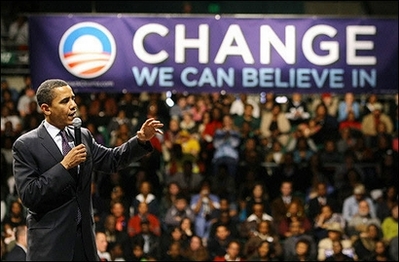
It’s hard to think of a single area of U.S. policy where then candidate Obama promised change and now President Obama has not completely reversed his former position and reverted to the policies of Bush & Co. Some may call Obama a socialist, but he has moved his position on almost every single issue, a shift that he himself seems to justify as finding middle ground; ironically the middle is in right field. I guess the only change we can believe in now is Obama’s change of heart.

In a series of excellent articles over the past few days, Glenn Greenwald has exposed many of the hypocrisies in Obama’s Bushness and Democrats’ acquiescence to that Bushness:

Few issues highlight Barack Obama’s extreme hypocrisy the way that Bagram does. As everyone knows, one of George Bush’s most extreme policies was abducting people from all over the world — far away from any battlefield — and then detaining them at Guantanamo with no legal rights of any kind, not even the most minimal right to a habeas review in a federal court.  Back in the day, this was called “Bush’s legal black hole.”  In 2006, Congress codified that policy by enacting the Military Commissions Act, but in 2008, the Supreme Court, in Boumediene v. Bush, ruled that provision unconstitutional, holding that the Constitution grants habeas corpus rights even to foreign nationals held at Guantanamo.  Since then, detainees have won 35 out of 48 habeas hearings brought pursuant to Boumediene, on the ground that there was insufficient evidence to justify their detention.

. . . This is what Barack Obama has done to the habeas clause of the Constitution:  if you are in Thailand (as one of the petitioners in this case was) and the U.S. abducts you and flies you to Guantanamo, then you have the right to have a federal court determine if there is sufficient evidence to hold you.  If, however, President Obama orders that you be taken to from Thailand to Bagram rather than to Guantanamo, then you will have no rights of any kind, and he can order you detained there indefinitely without any right to a habeas review.  That type of change is so very inspiring — almost an exact replica of his vow to close Guantanamo . . . all in order to move its core attributes (including indefinite detention) a few thousand miles North to Thompson, Illinois.

As IOZ writes,

Considered historically, it will become clear that the job of Republican governments is to invent novel, ad hoc expansions of state power, while the job of Democratic governments is to consolidate and systematize them. Far from repudiating supposed Bush-era “excesses,” the Obama regime has sought–usually successfully–to entrench and to codify them. This is just the latest example.

Now that’s cynicism we can believe in. It makes you wonder whether what is most extraordinary about Obama’s presidency is just how ordinary his politics have become. I don’t mean to be a hater, but we need to demand more from our political class, and that includes the President. Continue reading

1 Comment

Filed under Essays, Obama 44

Why Can’t Soldiers Just Get Along?

tom-toles.gif

From Washington Post’s Tom Toles. Of course, the notion that they cannot is a fabrication of politicians.

Leave a comment

Filed under Essays

Robert Fisk: Tea with Bin Laden…and other stories

robert-fisk.jpg

“The distinguished Middle East correspondent of The Independent [Robert Fisk] recalls the culinary highs and lows of an extraordinary career – from feasting with kings in Jordan to eating under fire in Afghanistan.”

Robert Fisk: Tea with Bin Laden…and other stories:

When the Iranian Revolutionary Guards closed the roads to journalists after Ayatollah Khomeini’s return from exile in 1979, I decided to travel the country by rail. Secret policemen and soldiers always forget trains. They like road-blocks; and the journalist who wishes to elude them must remember Michael Collins’ old maxim, that no one ever sees a man on a bicycle. No one ever sees a journalist on a train. So Iranian state railways – and their single-carriage restaurant cars – became my home for weeks. Continue reading

Leave a comment

Filed under Essays