Wow ! What a year ! If I normally average in the low twenties, this year I read 38 books. I’m not quite sure what the exact reason was for being more prolific than other years. Maybe it was because I just didn’t watch much TV or movies at all, or it could be I simply got lucky with more fast paced page turners. Whatever the reason, I was on a roll.
Of note, I read my friend Alberto Cañas’ first novel. I also read lots of books that take place at sea or lost on a deserted island, and of course, I tried to read my share of novels about Texas or the wild west.
Here is my 2025 list in reverse chronological order:
Captives and Companions: A History of Slavery and the Slave Trade in the Islamic World by Justin Marozzi (currently reading)
Maurice and Maralyn: An Extraordinary True Story of Love, Shipwreck and Survival by Sophie Elmhirst
The Wandering Hill by Larry McMurtry
The Sin Killer by Larry McMurtry
Flesh by David Szalay
The Tender Bar by J.R. Moehringer
North Sun; or The Voyage of the Waleship Esther by Ethan Rutherford
Quizás alguien esté marcando el camino by Alberto Cañas
The House of Mirth by Edith Wharton (re-read)
My Friends by Hisham Matar
Pressure Drop: Reggae in the Seventies by John Masouri
Open by Andre Agassi
Down the River unto the Sea by Walter Mosley
Genghis Khan and the Making of the Modern World by Jack Weatherford
The Wide Wide Sea: Imperial Ambition, First Contact, and the Faithful Final Voyage of Captain James Cook by Hampton Sides
There is No Place for Us: Working and Homeless in America by Brian Goldstone
A Voyage for Madmen by Peter Nichols
Eulogy by David Sparks
Theo of Golden by Allen Levi
Blessed McGill by Edwin Shrake
Isola by Allegra Goodman
The Safekeep by Yael van der Wouden
The Buffalo Hunter Hunter by Stephen Jones Graham
King of Ashes by S.A. Cosby
Careless People: A Cautionary Tale of Power, Greed and Lost Idealism by Sarah Wynn-Williams
Owning Up by George Pelecanos
Leo Africanus by Amin Maalouf (re-read)
The Man who Cried I Am by John A. Willams
G-Man: J. Edgar Hoover and the Making of the American Century by Beverly Gage
The Last Days of Ptolemy Grey by Walter Mosley
Dream Count by Chimamanda Ngozi Adichie
The Dream Hotel by Laila Lalami
The Bonfire of the Vanities by Tom Wolfe
String Theory: David Forest Wallace on Tennis by David Forest Wallace
I Who Have Never Known Men by Jaqueline Harpman
Destiny of the Republic: A Tale of Madness, Medicine and the Murder of a President by Candace Millard
James by Percival Everett
The City and Its Unknown Walls by Haruki Murakami
So many of these books were great reads, but if I had to pick just a couple as the best, surprisingly I would start Agassi’s memoir Open as my favorite, followed by Dream County, I Who Have Never Known Men, A Voyage of Madmen, and James.
This felt like my slowest reading year in recent memory. I only made it through some 22 books. I am not sure quite why, maybe because I read more non-fiction books or simply that I had trouble getting into fiction. With age, I am much more interested in the story and narrative than I am in clever writing. I don’t have time for detail and flowery language or for being impressed by the writing. I want good story telling. For example, I am currently reading Cold Mountain. The story keeps me going, but the artisanal writing style annoys the heck of me.
So here’s the 2024 list, including a few books that I read out loud to my kids:
Cold Moutain by Charles Frazier (currently reading)
What I talk about when I talk about running by Haruki Murakami
The Borderland by Edwin Shrake
The Mysterious Benedict Society by Trenton Lee Stewart
Wish by Barbara O’Connor
Never Split the Difference: Negotiating as if your life depended on it by Chris Voss
The Rediscovery of America: Native Peoples and the Unmaking of US History by Ned Blackhawk
The Copenhagen Trilogy by Tove Ditlevsen
The Man who Stayed Below by Alan Gould
New of the World by Paulette Jiles (re-read)
Horseman, Pass By by Larry McMurtry
The Pilars of Hercules by Paul Theroux
Holes by Louis Sachar
Blood Meridian, or the Evening Redness in the West by Cormac McCarthy
To Walk the World’s Rims by Betty Baker (re-read)
Sir Vidia’s Shadow: A Friendship Across Five Continents by Paul Theroux
The Lumumba Plot: The Secret History of the CIA and a Cold War Assassination by Staut A. Reid
The Maniac by Benjamin Labatut
The End of the World is Just Beginning: Mapping the Collapse of Globalization by Peter Zeihan
The Hundred Years War on Palestine: A History of Settler-Colonial Conquest and Resistance, 1917-2017 by Rashid Khalidi
The Armor of Light by Ken Follet
Bridge over Terabithia by Katherine Paterson (re-read)
The Covenant of Water by Abraham Verghese
By far, my two favorite books of the year where The Maniac and The Copenhagen Trilogy. In terms of great, simple stories, even though it’s middle and high school kids, I loved Wish. And as you can see, I continue with a Texas theme. I have spent a lot of time in Texas the past few years visiting, and I really enjoy learning about its history and reading novels set there. In this vein, I read The Rediscovery of America about Native Americans and the history of settler colonialism in the U.S. which reminded me too often of Khalidi’s The Hundred Year War on Palestine (also highly recommended).
My 2023 started off reading at record pace, but then as the year went by I ended up reading less books on average than other years. In theory, I could add to my list all of those books that I read to my kids, including the final three Harry Potter books and Judy Blume’s Fudge series.
Having spent time in California over the summer sparked my interest in the John Steinbeck classics I had never gotten around to be before, of which I absolutely loved East of Eden, and then to learn more about the history of Chinese Americans. Perhaps the highlight of the year was reading my friend Joaquin del Palacio’s first novel Todo puede empeorar published in November. If you’re a Spanish speaker, I couldn’t recommend it enough.
Here is the full 2023 list:
The Collected Regrets of Clover by Mikki Brammer
Ghosts of Gold Mountain: The Epic Story of the Chinese who Built the Transcontinental Railroad by Gordan Chang
Todo puede empeorar by Joaquin del Palacio
Grapes of Wrath by John Steinbeck
Ignorance by Milan Kundera (re-read)
Empire of the Summer Moon by S.C. Gwynne
Strategy: A History by Lawrence Freedman
The Wager: A Tale of Shipwreck, Mutiny and Murder by David Grann
Cannery Row by John Steinbeck
All the Sinners Bleed by S.A. Cosby
The Joy Luck Club by Amy Tan
King: The Life of Martin Luther King by Jonathan Eig
Our Share of Night by Mariana Enriquez
Patsy by Nicole Dennis-Benn
East of Eden by John Steinbeck
The Sweetness of Water by Nathan Harris
Saxophone Colossus: The Life and Music of Sonny Rollins by Aidan Levy
Are You There God? It’s Me Margaret by Judy Blume
Nights of Plague by Orhan Pamuk
It Ends With Us by Colleen Hoover
Prisoner of the Infidels: The Memoir of an Ottoman Muslim in Seventeen Century Europe by Osman of Timisoara
Empire of Ice and Stone: The Disastrous and Heroic Voyage of the Karluk by Buddy Levy.
My favorite of the year go to, as mentioned, East of Eden and Todo puede empeorar, as well as Empire of the Summer Moon (I also spent time in Texas), and Empire of Ice and Stone. I already have a long backlist of books to start off 2024 with.
This year I kept having the sense that I was way behind my normal reading pace, but somehow I still ended up reading 25 books. I wouldn’t say it was a great year. There was nothing particularly outstanding. Nevertheless, I really enjoyed The Lonesome Dove series, The Tress and Purgatorio. The Spanish Game, a spy novel set in the early 2000s Madrid, made me think I should go off somewhere to write a story about my first years in the city.
The big disappointments were the Stephane Crane biography which I found unreadable and Zorba the Greek which was just so bad and outdated. Anyways, here is the entire list in reverse chronological order:
Empire of Ice and Stone: the Disastrous and Heroic Voyage of the Karluk by Buddy Levy (currently reading).
Historic Tales of Gasparilla Island by David Futch.
Comanche Moon (Lonesome Dove, #4) by Larry McCurtry
Dead Man’s Walk (Lonesome Dove, #3) by Larry McCurtry
Slammed (Slammed, #1) by Colleen Hoover
The Trees by Percival Everett
Zorba the Greek by Nikos Kazantzakis
Stasiland: Stories from Behind the Berlin Wall by Anna Funder
A Heart So White by Javier Marias
Think Again: The Power of Knowing What You Don’t Know by Adam Grant
Afterlives by Abdulrazak Gumah
Years of Glory: Nelly Benatar and the Pursuit of Justice in Wartime North Africa by Susan Gilson Miller
The Spanish Game (Alec Milius #2) by Charles Cumming
The First 90 Days: Cri#cal Success Strategies for New Leaders at All Levels by Michael D. Watkins
The Devil Takes You Home by Gabino Iglesias
Winter in Madrid by C.J. Sansom
The Islander: My Life in Music and Beyond by Chris Blackwell
The Old Drift by Namwali Serpell
The Remains of the Day by Kazuo Ishiguro (a re-read)
In the Country of Others by Leila Slimani
Purgatorio by Jon Sistiaga
Streets of Laredo (Lonesome Dove, #2) by Larry McCurtry
Crossroads by Jonathan Franzen
Lonesome Dove (Lonesome Dove, #1) by Larry McCurtry
Aftermath: Life in the Fallout of the Third Reich by Harald Jähner
Burning Boy: The Life and Work of Stephen Crane by Paul Auster
In 2021, I read just over 30 books. That seems like a pretty good year for me ! Had it not been for TV bingeing, I could have read much more.
When 2020 came to an end, I was about half way through Obama’s memoir A Promise Land which is essentially his apology tour for not having taken greater advantage of his time in office. Nonetheless, the book is highly recommendable, no matter your political affiliation.
And as this year comes to an end, I am currently trying to make my way through the incredibly frustrating biography of Stephen Crane by famed novelist Paul Auster. I really would love to love this book. Sometimes I find myself enjoying it, but most of the time, I am just angry with Auster for making it feel interminable.
So here is my 2021 list in reverse chronological order:
Burning Boy: The Life and Work of Stephen Crane by Paul Auster (currently reading)
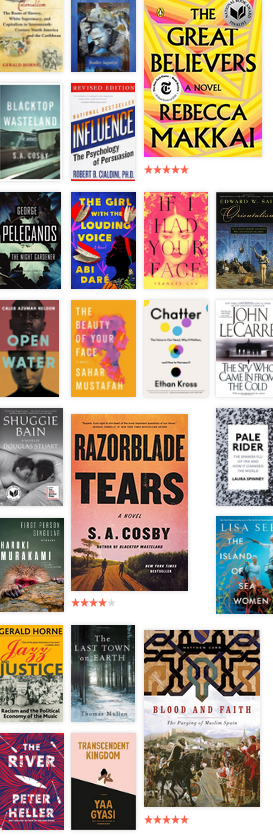
Transcendent Kingdom by Yaa Gyasi
The River by Peter Heller
Blood and Faith: The Purging of Muslim Spain by Matthew Carr
The Last Town on Earth by Thomas Mullen
Jazz and Justice: Racism and the Political Economy of the Music by Gerald Horne
The Island of Sea Women by Lisa See
First Person Singular: Stories by Haruki Murakami
Pale Rider: The Spanish Flu of 1918 and How it Changed the World by Laura Spinney
Razorblade Tears by S.A. Cosby
Shuggie Bain by Douglas Stuar
The Spy Who Came in from the Cold by John le Carré
Chatter: The Voice in Our Head, Why It Matters, and How to Harness It by Ethan Kross
The Beauty of Your Face by Sahar Mustafah
Orientalism by Edward W. Said
Open Water by Caleb Azumah Nelson
If I Had Your Face by Frances Cha
The Girl with the Louding Voice by Abi Daré
The Night Gardener by George Pelecanos
Influence: The Psychology of Persuasion by Robert B. Cialdini
The Great Believers by Rebecca Makkai
Blacktop Wasteland by S.A. Cosby
Don Drummond: The Genius and Tragedy of the World’s Greatest Trombonist by Heather Augustyn
The Apocalypse of Settler Colonialism: The Roots of Slavery, White Supremacy, and Capitalism in 17th Century North America and the Caribbean by Gerald Horne
Migrations by Charlotte McConaghy
The Vanishing Half by Brit Bennett
Writers and Lovers by Lily King
Homeland Elegies by Ayad Akhtar
Interior Chinatown by Charles Yu
American Dirt by Jeannie Cummins
This is Happiness by Niall Williams
The Duke Who Didn’t by Courtney Milan
A Promise Land by Barrack Obama
Hands down my three favorite books on the list were The Great Believers, Homeland Elegies, and Blood and Faith. The Great Believers takes us back to 1980s Chicago, the AIDS epidemic, how little we understood about the virus, and the stigmatizing effects on the gay community. Along with Pale Rider and The Last Town on Earth from this year’s list, The Great Believers helped put the current pandemic into perspective.
Over the past few years, I have read so many novels about first generation Americans and the psychological toll they pay straddling their parents’ culture and that of American society. This year these included Homeland Elegies, The Beauty of Your Face, and Transcendent Kingdom. By far, Homeland Elegies is the best I have read in a long, long time. A real magnum opus. In defense of Transcendent Kingdom, at first it read like just another one of the lot, but it turned out to be a richer and deeper novel about addiction, depression and faith.
After having spent a few days in Granada with my family, I couldn’t stop thinking about how after 1492, Spain couldn’t just replace an entire city population with another from one day to the next. That led to Blood and Faith, Carr’s history of how for a over a century after the end of the Reconquest, Spain systematically and brutally ethnically cleansed Spain of its Morisco population. Everyone interested in Spain and even contemporary politics should be knowledgeable about this history.
Finally, a few big disappointments. The Don Drummond biography was poorly told, but at least it inspired me to revisit Ska which I have been playing non-stop ever since. And Haruki Murakami breaks my heart. When I first read through his main body of work, he quickly became one of my all time favorite novelists. Over the years, I have gone back and re-read most of his novels and whenever a new book comes out, I always walk away wondering what I loved the first time around. Like a boxer or politician he should have stopped when he was still great.
I normally do not watch many TV series, and I have pretty much given up film all together. A couple times a year, I may watch a series or two, or when I need an easy smile, I’ll watch an old Seinfeld episode.
But in 2021 – and I don’t have a good reason why – I watched much more than in recent years. This ended up competing with my reading time. As you’ve probably heard me say a million times, I’ve had a bit of a Ted Lasso obsession (season 2 not so much). I also really enjoyed The Good Place which like Ted Lasso was about how we need other people in our lives to make us stronger and better human beings. Honorable mention to Borgen. I spent a few weeks pretending like I could speak Danish.
The Last Dance (which fascinated me and when I have time, I hope to write about as a contrast to Ted Lasso), The People v OJ Simpson and The Kings all made me reflect on the past, as I lived through those historical periods, often much more distracted by the trials and tribulations of my own day-to-day to consider their importance. I definitely enjoyed all three. I particularly liked learning more about Sugar Ray Leonard who lived down the street from me.
Finally, Squid Game was fun for the sole reason that it was Korean, and most of what we get to watch on Netflix et al is American with a couple of European exceptions. The acting was great, but otherwise it was just The Hunger Games for adults.
It’s hard to overstate just how much of a pathetic loser Donald Trump is.
Not only did he lose the election by over 7 million votes, the largest loss of any incumbent since Truman. Not only did he lose some 60 lawsuits, including two at the Supreme Court, in most never even alleging fraud and in others failing to provide any evidence of fraud whatsoever. Not only did he lose Georgia, where the Republicans did everything possible to making voting more difficult for African Americans from gutting the Voting Rights Act, closing polling places, making voters wait in line for 11 hours, blocking voter registration drives to rejecting 1000s of ballots. Trump just lost his party both Georgia Senate seats, handing the Senate to the Democrats. An incumbent hasn’t lost the presidency, the House and the Senate since Hoover, making Trump a Once in a Century Loser.
Now I know we are supposed to be sensitive to all the lost souls living in their extremist news bubble who let themselves be suckered into buying all of Trump’s phony, desperate – in need of medical attention – claims of fraud. But I don’t. Those assaulting the Capitol yesterday deserved to be tried and dealt with as terrorists, but as we know, in America, white guys’ hurt feelings always get treated with kid gloves.
Then Trump hammers the final nail in the coffin of the insanity of his presidency with a video message that is so psychotic, pathological and ridiculous that it is reminiscent of Hugo Chavez blabbering nonsense in his red tracksuit, or Baghdad Bob claiming US soldiers were committing suicide in the hundreds and that Iraq was destroying the US in the war, or Monty Python’s Black Knight sketch.
Abandoned by Pence, McConnell, Lindsey, and most of his White House staff (everybody except Ted-I-won’t-defend-my-own-dad-or-wife-Cruz), my hope is that those scenes at the Capitol yesterday were the pathetic but definitive demise of the “carnage” that was Trumpism and the last of the Trumpsters eagerness to be publicly punked and suckered by Don The Con.
Nothing we write about 2020 can start without the caveat that it has been a strange year. In a normal year, I average about two books per/month and generally reach around 24 books for the year. This year I struggled to hit 19.
The year started off pretty routine. I completed my last book of 2019 – Samantha Power’s memoir (coincidentally I am ending this year with Obama’s memoir) — and then did what I normally do, I turned to a George Pelecanos staple to pick up the pace. One day on my bus commute back from work (when no one thought twice about taking public transportation), I was listening to a podcast with an old interview of Mario Puzo where he talks about how his magnum opus was The Fortunate Pilgrim, not any of his mafia stories. So I read that, and then a variety of other books (including re-reading Dance Dance Dance) until finally Covid hit and the lockdown began.
During lockdown, I read the very appropriate The Plague, but also spent many nights reading about the virus. I didn’t touch Netflix, Disney Plus or Amazon Prime until the Fall. Instead I tried my hand at the Ken Follet Kingsbridge novels. At the end of the summer, I finally caved to the easy thrills of The Mandalorian, Cobra Kai, and then Seinfeld re-runs for lots of late 90s nostalgia.
So to make a long story short, there were lots of distractions from my normal reading pace, yet I was still able to get in some very good books. Here’s what I read this year:
How to Decide: Simple Tools for Making Better Choices by Annie Duke (currently reading)
The Promise Land by Barack Obama (currently reading)
A Column of Fire by Ken Follet
Pale Horse, Pale Rider by Katherine Anne Porter
Parable of the Sower by Octavia E. Butler
World Without End by Ken Follet
The Pillars of the Earth by Ken Follet
Deacon King Kong by James McBride
Black Wave: Saudi Arabia, Iran, and the Forty-Year Rivalry That Unraveled Culture, Religion, and Collective Memory in the Middle East by Kim Ghattas
Dance Dance Dance by Haruki Murakami (a re-read)
Shame the Devil by George Pelecanos
True Grit by Charles Portis
The Plague by Albert Camus
The Sweet Forever by George Pelecanos
Can’t Stop Won’t Stop: A History of the Hip-Hop Generation by Jeff Chang
The Fortunate Pilgrim by Mario Puzzo
Warrior of the Light by Paolo Coelho
In the Woods by Tana French
King Suckerman by George Pelecanos
The Kingsbridge series pretty much dominated my year. Of the three, A World Without End was my favorite as it takes place during the Black Death (which felt very timely). Kim Ghattas history of the cold war between Saudi Arabia and Iran to dominate the Muslim world by competing to push the extremist ideologies across the region was incredibly informative, as was Jeff Chang’s history of Hip-Hop culture. Dance Dance Dance like almost all of the Murakami novels I have re-read seemed much more flat and repetitive the second time around (which always breaks my heart because he has been one of my all time favorites). I loved The Fortunate Pilgrim which is an Italian immigrant family struggling to make it in Hell’s Kitchen during the Depression. I could imagine the characters as my grandmother and her brothers who suffered through the same time period and circumstances just a dozen blocks away. Butler’s excellent Parable of the Sower about an unraveled and dystopian American society felt all too possible. And of course, for a DC boy like me, anything by George Pelecanos is always enjoyable. All in all, though, I will go with A World Without End as my favorite read of the 2020, with Parable of the Sower coming in second.
It’s hard to find words to express just what Donald Trump has pulled off.
By all accounts, Trump lost in a historic blow out. Forty days after the election with all 50 states having certified, Biden won with 306 electoral votes and defeated Trump by some 7 million popular votes. Trump lost 57 times at court, including twice at the Supreme Court. Judges across the country, including many Republican judges and one appointed by Trump himself laughed him out of court. Regardless of all of his screaming and yelling about fraud, Trump failed to present any evidence of fraud at court (contrary to his stump speeches, many of Trump’s suits weren’t even alleging fraud). During Amy Coney Barrett’s confirmation proceedings, Trump stated that getting her on the Court would secure his ability to win the election, as if he expected to lose all along but hoped to prevail by stacking the Court in his favor. Nevertheless, all of his appointees ruled against him (twice).
All of this would mean a humiliating defeat for Trump. But not so fast. Since election day, we kept hearing Trump surrogates saying that the president deserved his day in court and that he had every right to exhaust his legal remedies. As any lawyer will tell you, the decision to litigate is essentially a business decision: is the risk of losing worth the financial investment? If a litigant has no money to put up but has a strong case, then he’ll have no problem finding a competent lawyer to do the work on a contingency fee basis, meaning the litigant only pays the lawyer if his wins the case. Furthermore, a reputable lawyer won’t put his name on a case that is doomed to failure, even if the client is paying big bucks. This is how the American free market manages frivolous lawsuits.
So step into Trump’s world. Trump puts up no money at all. None of the leading Republican election lawyers want anything to do with the case, and instead of agreeing to take the case on contingency, Rudy Giuliani increases his fees to the astronomical amount of $20,000/day regardless of having no expertise in election law. In other words, neither Trump or anyone around him actually believes that he will prevail.
But who cares, right? Trump is America’s greatest conman. One of the keys to being absolutely convincing is to show absolute conviction to your target audience (and that your audience wants more than anything to believe the con you are selling, like a make-it-rich-quick university degree). And that is exactly what Trump did and continues to do.
After collecting over $200 million in donations for his legal defense, of which Trump is only required to allocate 15% to the actual legal defense, Giuliani has lost those 57 cases I have mentioned. But again, who cares? Trump keeps screaming and yelling and people keep handing him over their hard-earned cash. Fifteen percent goes to Giuliani at a rate of $20,000/day and Trump gets to keep the rest for whatever yes whatever he wants. When you are racking in hundreds of a millions of dollars without having to win a single lawsuit, losing is a pretty lucrative business model. In fact, why would you ever want to win if the suckers keep paying you to lose?
But this is what confuses me: does Trump truly, honestly and sincerely believe that he is the biggest victim in American history — the victim of a conspiracy so wide, so vast and so deep that the entire American eco-system and all of its players, including Republican election officials, attorney generals, secretaries of states, and Republican appointed judges at all levels have conspired against him – or whether this is just Trump using his unique skills to pull off one final con job before leaving office? Either way, it is absolutely, undeniably pathological. Worse are all those suckers who keep falling for another classic Trump swindle.
A few quick reflections on the election after the election:
The Election Came Off Exactly as Trump Predicted
Donald Trump insisted that his constituents vote in person, that if he lost it would only be because of fraud, and therefore the winner must be declared on Election Night. For a number of reasons, it was widely predicted that Republicans would vote in person, Democrats would vote mainly by mail, and that it would take days to process the mail-in votes. Trump’s entire game-plan all along was to discredit those Democratic votes which would be counted last. In fact, it was so predictable that Republican legislatures in states like Michigan, Wisconsin, and Pennsylvania refused election commission requests to allow for canvassing and processing of mail-in votes prior to election day. The result was exactly as expected: a massive back-log of mail-in votes that would not be counted until after the in-person ballots were counted, allowing Trump to try to call the election early on Election Night and then claim all other votes were fraudulent.
When Trump called victory and cried fraud on Election Night prior to tens of millions of votes had even begun to be counted, it was clear that even Trump knew he had lost.
Crying Wolf – The Modus Operandi
Trump always lashes out, cries, whines and blames everyone else when he loses. He did the same when he lost the Iowa primary to Ted Cruz back in 2016. Trump has never taken responsibility for anything in his presidency. He blames everything on everyone else all the time. He often threatens lawsuit or demands investigations. It’s always pure theater. The lawsuits never happen and the investigations always miraculously disappear (think of his demands to investigate Hilary or FBI wrongdoing, most of the time the evidence makes Trump look even worse).
No one in American history has ever been treated as unfairly as Trump, right? During the past four years, everyone from local and federal law enforcement to (Obama appointed and Mexican American) judges, the DOJ, State Department, Pentagon and Intelligence community, the Chinese government and the entire establishment press have been systematically corrupt for the sole purpose of victimizing Donald Trump. Forget police killing innocent people, the fact that more Americans are imprisoned in the US than in any other country (the vast majority for non-violent crimes), or that now over 200,000 Americans have died of Covid . Forget that the Republican party has “gutted Voting Rights Act, sabotaged USPS, closed polling places, purged voters, attacked mail voting, tried to throw out ballots & fabricated evidence under oath”. Trump is America’s biggest victim.
The Press Does Not Decide Who Won
Neither does Donald Trump, who demanded to be called victor on Election Night. The custom (but not the law) in American politics is that when it becomes absolutely clear that one candidate has a share of the votes beyond the margin of error, then normally the following happens: (i) the press calls one of the candidates the winner, and (ii) the losing candidate gracefully concedes. But the presidency is only granted to a candidate when (i) each state has certified the winner in its respective state, (ii) the electoral college meets, (iii) the elector college gives the votes to Congress, (iv) Congress counts the electoral college votes, (v) the candidate is sworn in. When it appeared that Hillary would demand recounts, Trump surrogates went ballistic.
A Biden Landslide
This election saw record turn-out, and even though Trump got more votes than any other losing candidate in history, it appears that when all is said and done, Biden will have won by +5 million votes, the highest percentage in half a century, and the largest margin won by a presidential candidate challenging an incumbent since FDR.
Furthermore, Biden appears to have split the ticket. Republicans voted for him for the presidency but then voted for Republican congressmen down ballot. That means that Biden in fact helped Republicans win congressional elections more than Trump did. It’s hard to see how fraud would have been possible on the top of the ballot but not the bottom.
The Election Results Will Not Change
In any election, especially close elections there are always a number of irregularities, and states have mechanisms for addressing them. This is why it take states days to review, collect and recount ballots before certifying their final results. In states like Michigan, Pennsylvania and Georgia we would expect to see recounts, in accordance with local law, where the vote margins are below a certain thredhold. In the states where Trump is contesting the election results, the vote differentials appear to be well above the threshold where a Trump challenge would overturn the election results. Even Republican loyalist Carl Rove admits Trump will not be able to overturn the election results.
There is No Fraud
While there may be irregularities that are corrected by the normal processes, not a single state election commission has presented any case of voter fraud on the scale that Trump is claiming or in any way that would change the outcome of the election. In fact, election officials are directly contradicting Trump. Here is the Philadelphia City Commissioner (a Republican) saying that his team has seen no evidence of fraud and that he is receiving death threats for “counting votes … in a democracy”.
And in one case Trumpsters were hanging their hats on, the postal worker who alleged witnessing vote tampering has since recanted. He had been paid $130,000 by the GOP.
Trump is Not Entitled to His Day in Court
We keep hearing the simplistic soundbite that Trump is entitled to his “day in court”. That is just not correct and isn’t how our judicial system works. First Trump needs to establish a basis under state law (in each state where he is contesting the election results) for bringing a claim. There are series of things that a court will look at when they decide whether to hear a claim, like whether (i) there is a cause of action , (ii) the court has the power to remedy the claim, and (iii) the remedy would in fact change the outcome of the election. In other words, the courts don’t just give people their “day in court” because the plaintiff is upset with something not going his way. Entertaining grievances just because is a waste of tax-payers’ money and the judicial system’s resources.
As a result, Trump’s ability to overcome a motion to dismiss seems incredibly unlikely. In other words, Trump almost certainly will not get his day in court. So far Trump is losing case after case in state courts, and law firms are dropping him.
Who’s Going to Pay for Trump’s Lawsuits
In addition to the normal barriers that courts put on litigants to avoid their dockets being filled with frivolous lawsuits, lawyers’ fees are usually one of the biggest deterrents to litigation. So who is going to pay Trump’s legal fees? Certainly not Trump. We do know that Trump is hoping to con his supporters into donating to his legal case (but in the process they’re mainly just paying off his campaign debt). Now we see that Attorney General Barr is trying to pull in the DOJ to get tax-payer money to cover some of Trump’s fishing expedition. So whenever you hear Trump or his supporters say he is going to fight this, follow the money to see who the real sucker is.
Tax-Payers Have Had to Pay More because Trump is Trump
During Trump’s entire presidency, tax-payers have had to fit the bill for Trump’s constant visits to his golf clubs and resorts (mainly because he didn’t like Camp David or hanging at the dumpy White House). This would not have been the case with any other president. So if putting up with Trump’s fraud claims is about humoring his narcissism and inability to accept losing, then again the tax-payer and the entire government infrastructure is stuck with fitting the bill for an eggshell president.
What’s Trump’s End Game?
Narcissism aside, we are often told that Trump is above all else transactional. Pretend for second that you believe that Trump is a master dealmaker. In that case, Trump’s entire temper-tantrum isn’t because he actually believes there is fraud or has any intention to litigate but rather he is using his concession as leverage. So what would Trump want in exchange for a deal to concede? Maybe state and federal immunity for him and his family? Maybe he is just trying to milk his supporters for money to cover his costs. Maybe it is pure narcissism after all, and he is trying to convince himself that he is not a loser but the greatest victim in American history. The greatest I say!
What’s the GOP’s End Game?
It is undoubtedly clear that Trump will not succeed in altering the final election results in court. It is also clear that Republican Senators who just won will be in office for the next six years and therefore don’t need to pander to Trump anymore. I can then only think of two reasons why an elected Republican congressman would roll with Trump’s cry-baby narrative: (i) Republicans need to rally Trump’s most ardent supporters in order to win the Georgia senatorial run-off and thereby retain their Senate majority, and (ii) there is no new Republican front-runner to take Trump’s place. The ones shouting the loudest are the ones who are contending for that role.
What Happens to the Biden Coalition?
Bide won not be inspiring the Left but by building a coalition of those who could not stand Trump any longer. These included the entire array of Democrats from progressives like AOC and Sanders to right of center Democrats like Biden himself. It also included the Lincoln Project folks, Never Trump Republicans and foreign policy hawks. The success of this coalition also meant that many Republicans who voted for Biden, down ballot voted for Republican congressmen. In other words, Biden’s sweep of the presidential election did not translate into a Democratic sweep of Congress. The younger generation of his party leans progressive but Biden has always leaned right. If Biden sides with Republicans, he’ll lose his party’s base, and if he sides with the progressives he’ll lose the Never Trumpers. When push comes to shove, Biden’s intuition will take him to the right, and no matter how he leans, Mitch McConnell will always push him further to the right. It is just a matter of time before the Democratic party is in chaos.
The Old Man and the Transition
When my eldest son saw Biden on TV a few weeks ago, his reaction was, “that guy is so old”. Biden appears too old to maintain the rigorous schedule of a younger president like Clinton or Obama. I am not convinced he will last the full term. This reminds me of when Pope John Paul II passed away and the Vatican named the elderly Benedict XIII to replace him. Sometimes you need an old person to act as the short-term buffer when the democratic institutions and society cannot handle the need for radical change that the times demands.
Coke vs. Pepsi
On the eve of the election I was watching French television making fun of US politics. One of the jokes was that the American presidential election was between two candidates: one who was right wing and the other who was right wing. At the end of the day our entire political spectrum has been reduced to nothing more than an irrational tribal choice between two groups that are about as different as Coke and Pepsi. And when all is said and done – regardless of trumped up issues like abortion or guns geared to make voters choose a brand – both govern in exactly the same way and for the benefit of the same elite corporate and private interests. This year the difference – which did feel important to me – was that one party was represented by an offensive cartoonish conman with no respect for anyone or anything other than himslef. The other guy really didn’t matter.
Along the lines of what Van Jones said, Trump losing makes it so much easier to sell to our kids that lying, cheating, insulting, calling people childish names, and disrespecting others just doesn’t pay.
UPDATEDNovember 13, 2020:
A TV Gig
In my original post, I stated that Trump being transactional was likely withhold conceding in exchange for something: maybe for immunity from prosecution or simply for his ego. Now that it is absolutely clear that Biden won, Trump has no leverage left. All he can do is try to salvage his winner-persona with his loyal fans. Over the last decade — according to leaks of his tax filings — Trump has only made money from his salary as a TV personality while his real estate ventures have largely been failures. I’m pretty convinced now that Trump’s endgame is a Hannity-like TV show where he can pontificate to his loyal followers and finally rake in some easy cash. Not his own network to compete with Fox, but a talk show where he parlay his victimization-persona to a group of loyal followers.










 Grave Error