Category Archives: Essays

Voters are Dumb

Voters are dumb.jpg

In this article from The Economist, Lexington explains how most voters are incredibly ignorant when it comes to most issues. Even if voters are generally ignorant about the great majority of issues, this shouldn’t be a problem. That is precisely why we have a representative democracy — so that someone else can do the thinking, studying and evaluating for us. Nevertheless, voters are also irrational because the political issues upon which they base their votes, if implemented, actually go against their interests.

[There are] four biases that prompt voters systematically to demand policies that make them worse off. First, people do not understand how the pursuit of private profits often yields public benefits: they have an anti-market bias. Second, they underestimate the benefits of interactions with foreigners: they have an anti-foreign bias. Third, they equate prosperity with employment rather than production: Mr Caplan calls this the “make-work bias”. Finally, they tend to think economic conditions are worse than they are, a bias towards pessimism.

In other words, voter ignorance is not a problem in itself. The problem lies in the fact that voters’ irrationality causes them to elect politicians who will ultimately promote policies that will negatively affect the voters. And worst of all, the voters will never understand that it is their own idiocy that eventually causes them harm.

In any event, here is The Economist article in full: Continue reading

8 Comments

Filed under Essays

The Problem We Live With

Norman Rockwell - the problem with live with.jpg

Yesterday, I started a nice debate with my post on the Increase in Immigration and the Decrease in Crime. An unknown gentleman, named Mustapha (not to be confused with my friend from the post on changing names), entered the debate and gave a very interesting explanation on why he feels that immigrants (like himself — he is Nigerian American) eventually succeed in assimilating and overcoming racism by accepting “whiteness” while African Americans continue to struggle to find their place in white America.

Note that immigrants, be them from Europe (white) or from other parts of the world (Asia, Latin America, and elsewhere), have always suffered some form of racism/xenophobia in the first generations (including my father’s family as Italian Americans). Actually, I once had an Immigration Law professor who argued that America was essentially anti-Catholic, and that was why discrimination against immigrants has always been mainly directed towards Catholic immigrants (Irish, Italians, and Latin Americans).

Back to the debate: agree or not with his analysis, I think that Mustapha’s comments are well worth reading for anyone interested in the great complexities of race relations and their historic legacy, American cultural diversity, and the US as an immigrant-built nation. Here is his commentary: Continue reading

Leave a comment

Filed under Essays

An Increase in Immigration and a Decrease in Crime

Police US.jpg

Most people wrongly associate an increase in immigration with an increase in crime, regardless of the obvious fact that immigration is an economic phenomena. People leave their families and countries behind because of an economic opporunity abroad. If there weren’t any job opporunities in the recipient country, then there wouldn’t be immigrants. Thus, immigrants simply fill a specific demand in the recipient country for work.

So why do nationals always blame immigrants? Because people like to blame others for their own shortcomings. But the fact of the matter is that the great majority of crime is and has alway been committed by the home grown.

In an article that I was just reading in The Economist today about how crime continues to fall in America’s biggest cities, The Economist highlights the fact that one of the reasons is that immigrants are entering the cities while the lower income class Americans are moving out. According to The Economist Continue reading

19 Comments

Filed under Essays

Rubalcaba, ni firme ni inteligente, solo comadreja

Rubalcaba.jpg

Alfredo Pérez Rubalcaba quizás no admitirá jamás haber cometido graves errores en el caso De Juana Chaos. Pero no hace falta que lo haga, sus palabras anteriores las conocemos todos. A ver si el gran comadreja del PSOE, artífice de las negociaciones de “paz”, será suficiente listillo esta vez. Seguro que sí. Ya está montando la ofensiva al PP por su propio fracaso y por haberse quedado en ridículo ante los terroristas totalitarios.

A ver si entendemos mejor la lógica del señor Rubalcaba quien en marzo reconoció haber tomado la decisión “personalmente” “tras una larga reflexión” de dejarle a De Juana Chaos fuera de la carcel porque “a diferencia de los terroristas, a nosotros sí nos importa la vida, es nuestra mayor legitimidad moral“. “El Estado debe aplicar la ley, ser humanitario, firme e inteligente“.

Sin embargo, ahora a Rubalcaba le dan igual los motivos humanitarios (porque nunca los hubo), “De Juana no será trasladado a su domicilio cualquiera que sea el dictamen médico que nos proporcionen, quiero que quede absolutamente claro.” Entonces ¿a qué se basa para tomar decisiones firmes e inteligentes? Continue reading

Leave a comment

Filed under Essays, Living la vida española

El Inicio del Comienzo del Fin de los Principios

zapatero.jpg

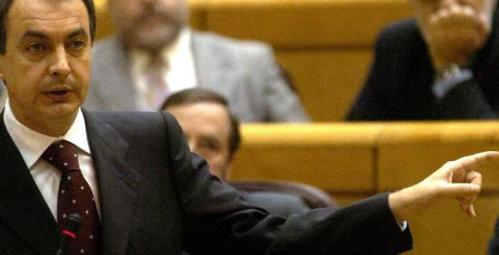
Si hace más o menos un año y pico Zapatero declaró que España estaba ante el incio del principio del fin del terrorismo de ETA y si ahora hemos llegado al fin de la tregua, tengo una pregunta: ¿cúando fue el inicio del principio del fin del Alto el Fuego? ¿Fue en la Terminal 4? ¿O nunca se inició el comienzo del prinicipio del fin?

¿Dónde estuvo el sentido común todo este tiempo? ¿Cuándo fue el inicio del comienzo del fin de los principios?

1 Comment

Filed under Essays, Living la vida española

In a Free State

In a free state.jpg

Last night I finished In a Free State by V.S. Naipaul, the 2001 winner of the Nobel Prize for Literature. I had previously read A House for Mr. Biswas and A Bend in the River. In a Free State is really three novellas dealing with individuals who have all left their homelands in search of some form of freedom (all for various different reasons) and have eventually found themselves even further lost than before. Continue reading

Leave a comment

Filed under Essays, Literature

The U.S.: Love It or Leave It

Robin Williams.jpg

I received an email with this Robin Williams monologue about how the U.S. should deal with peace in the world by essentially telling the world to screw off and shutting U.S. borders. Of course, it is tounge-and-cheek, and I have not verified whether it is really attributable to Williams. Nevertheless, I think his argument is rather infantile and simplistic. It is the typical “if you don’t like it, then leave” response you get in every wealthy country around the world when someone complains.

So basically he argues that if foreigners complain about U.S. foreign policy, then the U.S. should stop doing all of those things that actually have a great benefit to the world. As I have said, this is rather silly. It is like an abusive father saying that if you don’t like the way he treats you, then you should support yourself; or an abusive boss who tells you that if you don’t like it, then get a different job. The U.S. needs to stop living in the past, for example, by saying that Europeans should thank us for World War II. Just because we do or did some good, doesn’t mean that we have carte blanche. I know you should not bite the hand that feeds you, but just because you give out a few small hand-outs, doesn’t mean that you are free from criticism.
In any event, here is Robin Williams: Continue reading

13 Comments

Filed under Essays

The Clintons and the Feminist Sell-Outs

klimt-girlfriends.jpg

Yesterday I was reading The Economist article “Hillary Clinton, Her latest incarnation: presidential front-runner“. This does a very good job of describing Hillary’s strengths and weakness and explains why she is presently in the best position to win America’s top political post. The way things look, Hillary will most likely win the primaries and become the Democrat’s candidate. Some pundits say that Hillary can beat Obama but would lose to Giuliani, whereas Obama would lose to Hillary but beat Giuliani. Who knows? Personally, I would prefer to see Obama win the national elections, not because I am per se in favor of his positions, but I think that the U.S. does not need two things that a Hillary victory would bring to the American political scene: (i) more divisiveness (especially after George W.’s divisiveness) and (ii) further another political dynasty (adding the Clinton’s to the Bush’s and Kennedy’s).

In any event, what really caught my attention in The Economist’s article was the following sentence: “[Hillary] is lionised by feminists and demonised by cookie-baking traditionalists.” This reminded me of something that really upset me back in 1998-99 during the whole Clinton-Lewinsky comedy — how Feminists abandoned their core beliefs to blindly follow both Bill and Hillary. Continue reading

7 Comments

Filed under Essays, Obama 08

A Fat Country: The Politics and Sociology of Food

botero-fernando-the-letter.JPG

My friends in Spain often accuse me of being blindly pro-American and only criticizing Europe. I always defend myself by saying that this is in fact not at all true. I critique what I see around me. After perhaps sounding too critical of the Mama’s Boy Society, I am going to highlight some of the problems associated with obesity in the United States.

At dinner on Friday night, Loic played with the idea of creating an online community for overweight people to be called AFatWorld (see video) where communities could use a WiFi scale (the La Fatera) and share their weight with their friends and other community members. Actually at the time, I was sitting at another table that was engaged in a much more interesting discussion on the success of Internet dating sites.

In any event, Felix Petersen, co-founder of Plazes, and I had a very interesting conversation about the politics of food. Continue reading

9 Comments

Filed under Essays

Individual vs. Collective Violence

calle_San_Bernardo_Madrid_altura_San_Vicente_Ferrer.jpg

Last night in Madrid, police and young Madrileños clashed in the Madrid neighborhood of Malasaña. A few years ago, the city prohibited what is known as botellón, or the public consumption of alcohol. The practice of botellón is very common amongst teenagers who prefer to gather in parks and plazas to drink alcohol instead of paying for their drinks in bars. In any event, May 1st and May 2nd are holidays in Madrid and the main plaza in Malasaña is called the Plaza Dos de Mayo (in honor of Madrid’s resistence to Napoleon) and in recent years has a been favorite botellón spot. Thus to celebrate the holiday and to resist what they must perceive as as an assault on their inalienable right to public drinking, the youngters defied the law and the police attempted to stop them. All in all, some 100 people (about 50% of them police) were injured.

This is not the first time the police and youth have battled it out over the right to botellón. What I find interesting is that individually, people in Europe (especially in Spain) are generally not violent, but in groups they are. This was also seen last night in similar, yet unrelated, protests in Berlin. Europeans are also violent when supporting their soccer teams. On the other hand, in the US people do not tend to protest violently or in support of their professional teams. Individuals are dangerous, not the masses. Add to that guns and dark streets and the fact that crowds are always more predictable than individuals, and the US becomes a scary place. Meanwhile, Madrid is incredibly safe, even when walking alone late at night. There are no guns. But, put a bunch of people together and a seemingly absurd political cause, and you have a small riot on hand. We often see images of police brutality at a traffic stop in the States, but never the police clashing with a crowd. The opposite occurs in Europe.

In the US there is individual violence. In Europe there is collective violence.

8 Comments

Filed under Essays, Living la vida española