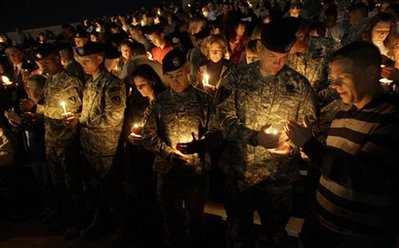
In light of the recent Fort Hood shooting and the debate on whether to increase troop levels in Afghanistan, it is interesting to note the obvious: fighting “terrorism” in Afghanistan has absolutely no effect whatsoever on the ability of any crazy person or groups of crazy people to perpetrate heinous acts within the U.S. Had we already been fighting in Afghanistan pre-911 (before the Patriot Act, domestic surveillance of emails and phone calls, extraordinary rendition, black sites, Guantanamo, torture, drones, and countless civilian collateral damage), we would not have prevented the worst terrorist attack in U.S. history, nor the Madrid bombings, nor the ones in London.
And yet, we fight on. There will be blood. Americans demand it, somewhere, anywhere, to whomever. Just far away from home.
I just read two interesting articles from two different sides of the political spectrum, surprisingly both in agreement, on why the Fort Hood shooting was not, by definition, terrorism.
Terrorism is, by conventional definition, an attack on civilians intended to strike fear in the non-military population in order to advance a political or ideological agenda. Hasan didn’t attack civilians, he attacked uniformed members of the U.S. Army in advance of their deployment to the frontlines. It was an evil act, but was it an act of terrorism?
The progressive Glenn Greenwald explains the problem with using a more expansive definition of terrorism:
But if one accepts that broadened definition of “terrorism” — that it includes violence that targets not only civilians but also combatants who are unarmed or not engaged in combat at the time of the attack — it seems impossible to exclude from that term many of the acts in which the U.S. and our allies routinely engage. Indeed, a large part of our “war” strategy is to kill people we deem to be “terrorists” or “combatants” without regard to whether they’re armed or engaged in hostilities at the moment we kill them. Isn’t that exactly what we do when we use drone attacks in Pakistan? Indeed, we currently have a “hit list” of individuals we intend to murder in Afghanistan on sight based on our suspicion that they’re involved in the drug trade and thus help fund the Taliban. During its war in Gaza, Israel targeted police stations and, with one strike, killed 40 police trainees while in a parade, and then justified that by claiming police recruits were legitimate targets — even though they weren’t engaged in hostilities at the time — because of their nexus to Hamas (even though the Israeli human rights group B’Tselem said the targeted recruits “were being trained in first aid, human rights and maintaining public order”).
And on this point, incredibly, Goldberg agrees:
In Pakistan, we launch missiles at people’s homes with civilians in or around them to take out al-Qaeda leadership. The attacks are — hopefully — always intended to be something of a surprise. But I wouldn’t call that terrorism. I’m just uncomfortable with the word terrorism metastasizing into “anything the bad guys do to us.” Why not call what Hasan did a war crime? Terrorism is a war crime but not all war crimes are terrorism.
On another note, during World War II, we interned Japanese Americans because their ethnicity alone made them suspicious. It will be interesting to see how the U.S. deals with Hispanic Americans (now roughly fifteen percent of the population) if we someday invade a Latin American country. When will Hispanic Americans disagreeing with U.S. policy be considered sympathetic towards or suspicious of terrorism? With such a large portion of our military personnel being Hispanic, that’s a lot of screening.
There are voices in the past few days, mainly from the far right, that are blaming “political correctness” for not promptly linking the Fort Hood shooting by a Muslim American to Islamic extremism. As I have already argued, we always come up with some inane excuse to push under the rug the All American shooting spree.
This narrative [of Islamic violence] is embraced by a small minority. But it has caused incredible amounts of suffering within the Muslim world, in Israel, in the U.S. and elsewhere. With their suicide bombings and terrorist acts, adherents to this narrative have made themselves central to global politics. They are the ones who go into crowded rooms, shout “Allahu akbar,” or “God is great,” and then start murdering. [Emphasis added]
Get rid of the “God is Great” part and what should we call that varied class of Americans who regularly do the exact the same? Brooks could be speaking about Americans. He continues,
The conversation in the first few days after the massacre was well intentioned, but it suggested a willful flight from reality. It ignored the fact that the war narrative of the struggle against Islam is the central feature of American foreign policy. It ignored the fact that this narrative can be embraced by a self-radicalizing individual in the U.S. as much as by groups in Tehran, Gaza or Kandahar.
It denied, before the evidence was in, the possibility of evil. It sought to reduce a heinous act to social maladjustment. It wasn’t the reaction of a morally or politically serious nation. [Emphasis added]
Brooks has made my point. We always reduce the heinous act of the great American shooting spree to social maladjustment. We talk, just as we did here, about early warning signs, but we never seriously discuss why going postal is such a frequent occurrence in American life or why we allow people such easy access to deadly weapons. Addressing our gun laws or questioning our character would be “political incorrect” and put our exceptionalism into question.
So, Mr. Brooks, when have we ever reacted after shooting spree as a “morally or politically serious nation”?
Finally, it would be ironic if it takes a Muslim American acting like an All American to finally change the way the pro-gun absolutists view easy, quick and unhindered access to weapons. The argument, as used after the Virgina Tech shooting, that more guns will protect us from guns doesn’t hold weight when the shooting occurs on the largest military base of the most militarized nation on the planet.
Another shooting spree, it’s become such an internationally recognized trademark of American culture that we should now say “as American as Apple Pie Going Postal.”
It is always a shock — and a cause for deep sadness — when a gunman fires malevolently at crowds of innocent people. We have seen it far too often: at Columbine High School in Colorado a decade ago; on the campus of Virginia Tech two years ago; at a center for immigrants in upstate New York in April; and in downtown Orlando, Fla., where a gunman shot and killed one person and wounded five others on Friday.
We always come up with a scapegoat to avoid pointing the finger at the violent, dysfunctional character of American society that produces and reproduces these tragic episodes. The fact that Major Nidal Malik Hasan was a Muslim American is no exception; it just gives us another easy excuse to avoid looking in the mirror. Remember how after Columbine the Republicans wanted legislation to publish the Ten Commandments in all high schools so students would know that killing was wrong? As if that were the root of the problem or even remotely constitutional.
Now it must be Islam or terrorism (it was insanity, not religion or ideology, when a right-wing Christian shot up the Holocaust Museum earlier this year). Ironically, it could take a Muslim American adopting the All American modus operandi for us to finally recognize that going postal is a our own homegrown, domestic breed of terrorism, committed by Americans of all stripes.
Regardless of what many of us think and the vision of our beloved Founding Fathers, it took the United States over a century to become a stable democracy. According to Rory Stewart, in the best of scenarios, Afghanistan can aspire to have the democracy of Pakistan in thirty years. In eight years, American tax payers have already shelled out $220 billion. Only 92 years to go.
In the recent web-exclusive of the Bill Moyers Journal, Glenn Greenwald describes how the U.S. can be defined as a warrior nation, a country that has been at perpetual war for decades now. Presidents, and Obama is now no exception to the rule, become almost obliged to continue the tradition of invasion.
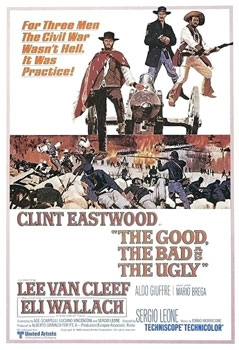
Putting our “There Will Be Blood” war-lust into perspective, Greenwald says,
I think the central problem is a lack of empathy. And my biggest wish is that if Americans– that every American in sort of a national collective exercise would spend just ten minutes thinking about the following question, which is:
Suppose there was a Muslim country that invaded the United States with 150,000 troops, and proceeded to occupy our country for the next eight years: dropped bombs on wedding parties, slaughtered men, women, and children who were innocent. Created prisons in our country, where they arrested American citizens and put us for years without charges. Created an overseas island prison where they shipped some of us to without any recourse whatsoever. And at the same time, were threatening to do that to several other Western countries. How much rage and anger and a desire for vengeance and violence would we feel towards that country that was doing that to us?
I mean, just look at what the singular one-day attack of 9/11, the kind of anger and rage it unleashed. And I think if Americans were to think about how we would react towards other countries, and what we would want to do to them, if they were doing to us what we are now doing to them, I think a lot of light would be shined on what it is that we’re really achieving in terms of our national security.
In a different interview, this one on Fresh Air, Jane Mayer discusses her recent article in the New Yorker on the use of unmanned drones to fight our wars, and points out one of the obvious moral problems with fighting high tech wars far away from home:
You know, right now, I think Congress is really infatuated with this technology. And you can see why, I mean it is a marvel. But the place where people are asking questions are in the human rights community, the international lawyers, the U.N.,. There are a number of sort of political philosophers asking questions, such as, you know, if there’s no – if we can’t feel the impact of the people that we’re killing and we can’t see them, and none of our own people at risk, does this somehow make it easier to just be in a perpetual state of war because there’s no seeming cost to us? These are the kinds of questions that people are asking.
Not to mention, as Mayer writes in her New Yorkerpiece that
The U.S. government runs two drone programs. The military’s version, which is publicly acknowledged, operates in the recognized war zones of Afghanistan and Iraq, and targets enemies of U.S. troops stationed there. As such, it is an extension of conventional warfare. The C.I.A.’s program is aimed at terror suspects around the world, including in countries where U.S. troops are not based. It was initiated by the Bush Administration and, according to Juan Zarate, a counterterrorism adviser in the Bush White House, Obama has left in place virtually all the key personnel. The program is classified as covert, and the intelligence agency declines to provide any information to the public about where it operates, how it selects targets, who is in charge, or how many people have been killed.
The CIA program is not only secret (and arguably committing illegal extrajudicial assassinations) but it is being outsourced to private military contractors and some of the attacks are on targets requested by the Pakistani government. In any event, I definitely recommend Mayer’s article as it attempts to present all of the facts without passing judgment.
There is a lot of talk these days about government run health care, government run banks, government run industries. But if you take even a simple cursory look at all of the evidence and our priorities – of who is being “helped” to succeed and who is being allowed to fail in our society – it is clear that the corporations run the government not the other way around. The banks are too big to fail and the rest of us are too small to succeed.
Our thirst for war, our lust for banking deregulation, and our pathological aversion to a public option all have a green paper trail leading from lobbyists to Washington. Were it just the Republicans taking the money, we could argue at least that there was some ideological nexus. But even key Democrats and pseudo liberals are on the payroll, as the New York Times reports here and the Washington Post reports here and here. According to the Post,
Nearly half the members of a powerful House subcommittee in control of Pentagon spending are under scrutiny by ethics investigators in Congress, who have trained their lens on the relationships between seven panel members and an influential lobbying firm founded by a former Capitol Hill aide.
In the above video (beginning at minute five), Glenn Greenwald describes the direct financial interests behind the positions that the liberals Joe Lieberman and Evan Byah hold on health care, regardless of the clear mandate of their respective electorates.
A few weeks ago in a debate on whether to increase troop levels in Afghanistan on This Week with George Stephanopoulos, three out of four guests, including influential war-loving Democrat Diane Feinstein, were all unquestionably and unapologetically pro-escalation. The only panellist against escalation, Rep Jim McGovern, was given considerably less time than the others. What kind of debate is that, Mr. Stephanopoulos? The highlight of the program was Feinstein, the Chair of the Senate Intelligence Committee, saying that all she knew about troop levels was what she read in the newspapers. In other words, we send troops to war based on what key members of congress read in the papers. It’s rare that we now need to look to George Will — a lone conservative who is in favor of pulling troops from both Afghanistan and Iraq – for a little ideological honesty.
Then we have the more likable, tempered and soft-spoken conservative David Brooks — who regardless of being wrong on every aspect of the build up to Iraq is still permitted to opine on Afghanistan – questioning President Obama’s resolve as a war president (as if the only option available to a “war president” is more guns), making the factually inaccurate, unsubstantiated and blatantly false claim that “like most people who have spent a lot of time in Afghanistan, believe this war is winnable.” Almost everything from the ground in Afghanistan points to the fact that we should get out ASAP (here, here, here, here, here, here, and here).
With a unanimous political and press corps in favor of the same corporate interests, it’s not too difficult to figure out who is receiving all of the entitlements and who is is running the show.
Here is the problem: conservatives want to blame the world’s problems on the tiny, irrelevant ACORN whose total government windfall is a mere drop in the bucket compared to the military contractors and war profiteers — such as Halliburton, Blackwater and the rest of the gang — who have all received and mysteriously made disappear billions of taxpayer dollars without any government scrutiny or oversight whatsoever. Congress could pass a law prohibiting companies convicted of fraud from participating in future government bids, but that would negatively affect the war profiteers, all of whom have previously been convicted of fraud and continue to be on the government payroll. All the conservatives really want to do is punish ACORN alone.
So now some ingenious Republicans have proposed legislation that would exclusively punish ACORN. This of course would be a Bill of Attainder, and Bills of Attainder are both clearly and explicitly prohibited by the Constitution (Congress legislates, the Judiciary adjudicates). The above video is from a funny exchange between Rep. Alan Grayson and Rep. Broun where Grayson educates Broun on the law. It’s nice to see how uneducated our legislators are on legislating. Either that or how little could care about the Constitution.
It was very nice to open the Washington Post this morning and find my friend and former boss, Angel Cabrera, right there on the front page of the online version. Angel was writing about global leadership, though I would not necessarily agree with his listing of the present Goldman Sachs CEO as an exemplary top executive.





 Grave Error