Monthly Archives: November 2008

The Great Depression and How You Get Got

I like George Will. I don’t generally agree with him on policy, but I do respect his intellectual curiosity and honesty, writing abilities, and ideological consistency (he sticks to his guns, even if it means criticizing his own party). Nevertheless, yesterday on This Week with George Stephanopoulus, an exchange he had with Paul Krugman, reminded me of something I used to emphasize back in my teaching days. It also reminded me of the lyrics from Mos Def’s “Got”.

On the first day of class when I used to teach a course similar to Legal Methods, I would always establish a very basic rule: students had to be completely honest about whether they had prepared for class. If they hadn’t done the reading, they had to say so. Likewise, if they truly were not sure of the answer to a question, they had to state as much. It was always better to acknowledge ignorance, than to try to b.s. your way through an answer. Most lay people will think that a lawyer’s job is to spread the b.s. on as thick as possible. But imagine you are up in front of a judge, and she asks you a question you know nothing about. Is it a good idea to try to wing it? The moment you give a b.s. answer to a person who knows more than you, every other answer that you gave or will give is automatically tainted.  You become nothing more than a b.s.-er, no content, no substance, no footing, no credibility.

Furthermore, you never know when the person next to you, judge or not, knows more than you do. Isn’t that why everyone in the U.S. lost all faith in Sarah Palin when she tried to sell us her silly “you can see Russia from Alaska” foreign policy qualifications? It’s what Mos Def would call “high posting when you far from home” and is one of the ways you can get yourself “got”.

So there was good old George Will sitting next to Paul Krugman, the guy who just won the Nobel Prize in Economics. And what does George Will try to do? Give some self-serving politically bogus analysis of the factors contributing to the Great Depression.

George Will: One of the ways we turned a depression into the great depression that didn’t end until the Japanese fleet appeared off Hawaii was that there were no rules and investors went on strike because government was completely improvising. Net investment was negative through almost all of the 30s because again people did not know the environment in which they were operating because the government had the fidgets and would not let rules and markets work.

Paul Krugman: This is not the way I read history, no . . .

George Will: Am I wrong about net investment?

Paul Krugman: No, net investment is negative because when you have 20% unemployment and all of the factories are standing idle who wants to build a new one. You don’t need to invoke the government to explain that. No, what actually happened was . . . there was a collapse of the financial system, which was not restored for a long time, there was a persistent deep slump in consumer demand, and therefore no investment demand, so you were stuck in this trap. Roosevelt got the economy moving somewhat. By 1937 things got a lot better than they were in 1933. Then he was persuaded to balance the budget or try to. And he raised taxes and cut spending. And the economy went back down again. It took a tremendous public works program, known as World War II, to bring the economy out of the Depression.

I still like George, but from now on I’ll probably be taking his historical ramblings with an even more generous grain of salt. Now, that’s a textbook recipe on how to get yourself got, Continue reading
1 Comment

Filed under Essays

Divorce Him Already

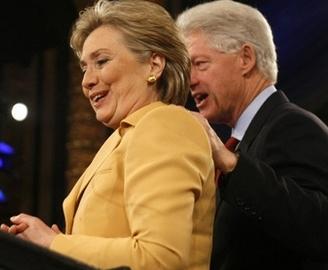
Hillary would not have been on the top of my list for Secretary of State. I would have envisioned her in a domestic policy role, thinking that one of Obama’s bipartisan choices would be better as the top foreign diplomat (like Republicans Chuck Hagel or Dick Lugar). Apparently, though, Hillary was blocked by Ted Kennedy in Senate from any health care czarship. As the story goes, with Obama most likely keeping Bob Gates on as Secretary of Defense, he therefore cannot also give State to a Republican. That leaves the political prize open solely to a deserving Democratic, and you’d think the likely front runners were John Kerry and Bill Richardson.

John Kerry endorsed Obama early on and Bill Richardson –Secretary of Energy and U.N. Ambassador during Bill Clinton’s presidency — earned Judas status when he came out in favor of Obama in the heat of primaries. As attributed to James Carville (also the guy who called Richardson Judas), the elections are for screwing your enemies and the transition for screwing your friends. Furthermore, making Hillary Secretary of State ties her political future to her performance in the Obama administration. Welcome to the team of rivals.

But as many recent articles have correctly pointed out — from Gail Collins and Maureen Dowd in the New York Times to the Washington Post’sClintons’ Global Paths May Cross“– Bill Clinton’s foundation, presidential library and baggage pose serious ethical questions to a potential Hillary State Department. George Stephanopoulos writes,

But there’s one significant complication: how to make sure that former President Clinton’s foreign speeches, business dealings and foundation work don’t present conflicts of interest . . .

Here are some of the major questions that need to be addressed: How much public disclosure must there be of past foreign donations to the foundation?

Is any more disclosure of foreign business and speaking income required? Are there other ways — short of or in addition to full disclosure — to vet for possible conflicts?

Going forward, would the Clinton Foundation be permitted to continue soliciting foreign support?  If so, under what conditions?

How would the contributions be reviewed and vetted?

All of these questions can be answered, but getting there is complicated. It’s not done yet.

Bill Clinton having to pay by the rules of transparency and disclosure? You really think so? Hillary should have dumped Bubba’s tuckus ages ago; it might have even gotten her elected president this time round. It’s not much of a marriage anyways, but if it is, at a minimum, one of convenience and she’d like to be Secretary of State, Hillary should be asking, “what has he done for me lately?” The answer is: divorce him already.

4 Comments

Filed under Essays

The Founding Fathers and Terrorism

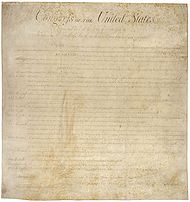
bill-of-rights.jpg

I was just watching a recent ABC News interview with William Ayers, the alleged terrorist pall of Barack Obama — a relationship Ayers calls a myth. With regards to his participation in the Weather Underground, Ayers insisted that he had never engaged in terrorism, but that the group had been reckless and some of their acts illegal. Nevertheless, he claimed that not enough was done to stop the immoral activities of the U.S. government in killing some 2,000 civilians per week in Vietnam.

In putting the Vietnam protests into context with today’s wars in Iraq and Afghanistan, Ayers said people should “participate in resistance, in nonviolent, direct action, and “Frankly I don’t think we did enough, just as today I don’t think we’ve done enough to stop these wars.”

ABC News reporter Chris Cuomo argued with Ayers that his activities against the government, because they were violent, were intrinsically wrong and amounted to terrorism.

In listening to Chris Cuomo’s argument, I was reminded of those who believe that the Constitution, through the Second Amendment, grants a federal right to bear arms. According to this historical analysis, the Founding Fathers believed in a citizen’s right to own, stockpile, and use arms to protect themselves against foreign invaders, all sorts of local threats, and even their own government.

They most likely cite the Right of Revolution from the Federalist Papers, written by Alexander Hamilton,

If the representatives of the people betray their constituents, there is then no resource left but in the exertion of that original right of self-defence, which is paramount to all positive forms of government; and which, against the usurpations of the national rulers, may be exerted with infinitely better prospect of success, than against those of the rulers of an individual State.  . . . The citizens must rush tumultuously to arms, without concert, without system, without resource; except in their courage and despair.

If the gun rights advocates – or even the causal proponents of this Second Amendment interpretation – are correct, then wouldn’t that fully justify Ayer’s brand of terrorism? Wouldn’t it even rationalize the Iraqi insurgency and make a persuasive argument that Iraqis, or the Palestinians for that matter, be permitted to arm themselves? Heck, wasn’t the American Revolution against the British itself an insurgency? The Minutemen were insurgents.

So I am wondering: if you interpret the Second Amendment to grant a constitutional right to bear arms, does that mean the Founding Fathers recognized terrorism and insurgency as justifiable actions? Is terrorism part of the fabric of American ideology?

I also wonder if Sarah Palin sees America as “so imperfect” that she’d pall around with gun rights advocates.

Leave a comment

Filed under Essays

The Moment

first-family.jpg

Ever since Obama won the elections and masses of Americans celebrated in the streets, I have been thinking about the moment’s duality: on the one hand, people poured into the streets to reclaim their nation’s identity (in light of everything, justifiably or not, the Bush Administration came to symbolize) and the almost indescribable historic jubilation in electing the country’s first ever African American president.

Then on Wednesday over a sandwich, I was reading “La (r)evolución de B. H. O.” in El Pais by M. Á. Bastenier. Bastenier tries to make the argument that Obama’s victory was not really turning point in American race relations but merely reflected a change in the country’s electoral landscape. In a complete misunderstanding of the American reality and a misinterpretation of the numbers, Bastenier writes that it is unclear whether Obama’s victory signifies an important shift in how Americans view race because (i) Obama received the same percentage of votes from whites as did Kerry in 2004, and (ii) the balance was tipped in Obama’s favor with respect to Kerry’s loss in 2004, not because of white voters, but because of the change in the demographics of the American voters. In other words, Obama didn’t win because he got more whites to vote for him but because there was a higher number of Hispanic and African American voters.

Bastenier does admit that Obama did not lose white voters, but in saying so, he totally misses the point. All evidence, at least numeric, points to the fact that Obama’s candidacy was race neutral. White Americans were not divided by racial prejudice but by political preference. In other words, people didn’t vote for or against Obama because he was black; rather they voted based on how they viewed the world politically. Thus, a white Republican vote was not a statement of racial prejudice, nor was a Democrat vote one of racial affirmation. The changing ethnic make-up of the American electorate is a reality that both parties, especially now the Republicans, will have to face in upcoming elections. Nevertheless, the fact that white voters — though their majority is decreasing — did not vote differently for a black Democrat this year than they did for a white one in 2004, is historically important. It means that the majority of Americans vote colorblind.

This, in fact, is the irony of the election. At the moment Obama’s victory was announced, as reflected in John McCain’s very moving concession speech, the historical importance was so great that all Americans, regardless of who they voted for, could partake in the groundbreaking moment. Had the election been nothing more than a mere referedum on race, then only one side could celebrate.

To educate Mr. Bastenier, the weary, or anyone else who is not familiar with American history, just take a look at the photo of the First Family-elect, listen to what Congressman John Lewis had to say a few hours before the results came on Election Night, or take the time to read these words from Bill Moyers’ essay about the watershed moment, Continue reading

Leave a comment

Filed under Essays, Obama 08

Closure

I am still looking for some closure after the historic moment on Tuesday night. While Obama has his transition team in full battle gear, I am stuck in my own transition phase to post-election life.

I was hoping to write something profound, wrapping everything up like in Frank Rich’s article in today’s New York Times. Then my friend, Teo, very subtly sent me this video saying that its time to move on.

Now that we have a president-elect, we should reflect on how poorly the American people and press scrutinized George W. Bush during his reign in office, especially the first term. No matter how popular the new president may be, we should always keep him in order.

7 Comments

Filed under Digressions, Obama 08

The False Prophecy and a Little Irony

Remember them Super Delegates? Back when change had trumped experience and the numbers pointed in only one direction, Hillary Clinton made a plea to the Super Delegates to ignore the math and consider her prophecy: Barack Obama was unelectable. White women wouldn’t vote for him, Hispanics wouldn’t vote for him, and as Bill Clinton said, “hard-working Americans, white Americans” wouldn’t vote for him. Then there were the big states like Pennsylvania and Ohio that only Hillary could carry. And finally, by following the Democratic Party rules, Michigan and Florida would surely go to the Republicans.

There was a moment, after McCain’s choice of Sarah Palin, when everyone questioned whether Obama should have picked Hillary (though I stuck to my original position that she was too divisive for Obama’s message). For all of Billary’s cynicism, I am proud to say that Americans proved the duo wrong. Obama dominated the female vote, held his own with the white male vote, and prevailed in the keys states of Pennsylvania, Ohio, Indiana, and Colorado. He took Michigan and Florida, and even stole Virginia and possibly North Carolina. Party unity? Not a problem, even with Bill and Hillary barely breaking a sweat.

There is even a little irony in the prophecy that Obama was unelectable because he was not vetted. Hillary’s negative attacks solved that problem, and there is a strong argument that the net effect of the Billary smears only made Obama stronger and more resilient for the general election. By the time McCain Palin were palling around Billary’s sludge, the American people had already made up their minds about Obama.

After all the prophetic claims of unelectablility, Obama went on to become the first Democrat to win more than fifty percent of the vote in a presidential election since Jimmy Carter. So much for prophecies. Continue reading

2 Comments

Filed under Essays, Obama 08

Revisiting Spanish Perceptions on Race

hamiltonracism.jpg

I recently wrote about European perceptions of race and the American elections. Yesterday while browsing through the election coverage on the major Spanish networks, I landed on a daytime talk show, La Mirada Crítica, right when one commentator (I don’t know her name) described Barack Obama as

Obama es que no es un negro negro, es un negro ilustrado, mira cómo anda, como se mueve, parece blanco. No es para nada la imagen que tenemos nosotros de un negro.

In other words, Obama was “not your typical black man”. He was an “enlightened black man” (“negro ilustrado“), “like Sidney Poitier,” and she mentioned his elegant and refined way of walking, talking, and dressing.

I would normally have disregarded this as an isolated incident, but none of the other commentators budged. This time I am not being just another American overly sensitive to political correctness due to his own country’s dreadful history. I am also not saying that this proves an epidemic of racism in Spain, for I do not believe Spaniards to be overtly racist. But while some apologists may argue (see comments) that the above remarks were not racist since the intention was to praise Mr. Obama, the remarks undoubtedly epitomize the racism inherent in the patronizing concept of the Noble Savage — the one who earns honorary white status by distinguishing himself from the pack through enlightened European modes of dress and speech (or through colonization and religious conversion).

As I pleaded in an earlier post on language and racism, Spain is due to have a serious conversation about how to talk about other races and cultures. Based on the American experience, better sooner than later.

1 Comment

Filed under Essays, Living la vida española

The Media Elite

Off the plane on her return to Alaska, Sarah Palin complained about the press’ gotcha tactics and the mainstream media elite conspiracy against her. It looks like Fox News was just inducted into the mainstream media elite club. Or maybe it is just mainstream to see through Sarah Palin.

Leave a comment

Filed under Essays, Obama 08

A Very Moving and Moved McCain

John McCain gave an elegant concession speech; unfortunately for him, his campaign wasn’t nearly as elegant. But, what a wonderful lesson he gave us all, especially in his kind words about Obama’s recently deceased grandmother. Last night, John McCain stepped up to and was visibly moved by the historic moment. He graciously and honorably became part of what we have always wanted to be.

Leave a comment

Filed under Essays, Obama 08

My Election Night on Spanish Talk Radio

la-linterna-2.jpg

Last night I had the unique opportunity to speak, unofficially, in support of Barack Obama’s candidacy on a popular Spanish talk radio show hosted by César Vidal. The program was La Linterna and the station was the very right wing COPE. As a matter of fact, while waiting in the booth minutes before going on, I was so surprised by some of the shocking claims coming from the next room —  for example that Obama would close the borders to all foreign trade or that FOX News was the only impartial news source in the U.S. — that I almost reconsidered going on.

But when I was finally up, Mr. Vidal and his regular troops (Florentino Portero, Javier Somalo, Gabriel Albiac, and the show’s production team) were extremely friendly and welcoming. I was also joined by two Republican women, one from Republicans Abroad and the other from Spain for McCain. At first, it was a little difficult to get my sea legs and feel totally comfortable expressing myself on the radio in Spanish, but eventually, I was ready for a good discussion. In listening to the above now, I must admit that I am incredibly embarrassed by my lack of eloquence (I don’t go on until around minute 30).

My goal from the beginning was to present an American voting public in support of Obama that was above the name calling and divisiness. While the woman from Republicans Abroad appeared to follow the same tone, the one from Spain for McCain was much more confrontational and accusatorial, also bringing up those absurd Obama shutting the U.S. borders claims and pushing McCain’s counter-intuitive fiscal stance. Unfortunately, I did not have the opportunity to call her on the obvious facts: not only has Obama not proposed any such thing, but the Bush Administration with John McCain in the Senate has the worst record on trade protectionism and spending in recent history. But why bother; Americans have made up their minds, and today the McCain arguments are moot. Continue reading

5 Comments

Filed under Living la vida española, Obama 08