
Rachel Maddow deconstructs Obama’s prolonged detention policy. Obama now owns the propaganda.
At least it is refreshing to see that some serious criticism is finally aired on a mainstream news outlet.
Rachel Maddow deconstructs Obama’s prolonged detention policy. Obama now owns the propaganda.
At least it is refreshing to see that some serious criticism is finally aired on a mainstream news outlet.

Another great Glen Greenwald piece from late last week exposing our national hypocrisy:
U.S. Congress to finally stand up against torture?
Yesterday, President Obama approved a proposed civilian nuclear technology-sharing agreement between the U.S. and the United Arab Emirates and requested its execution, but CNN — in one of the all-time most unintentionally hilarious articles ever written — reports that its ratification is in doubt:
WASHINGTON (CNN) — President Obama on Thursday sent a civil nuclear agreement with the United Arab Emirates to the Senate for ratification, but its passage remains uncertain, thanks to a recently disclosed video.
Senior U.S. officials said lawmakers critical of the deal could use the video, which shows a member of the UAE government’s royal family torturing a man, to argue the United States should not have such nuclear cooperation with a country where the rule of law is not respected and human rights violations are tolerated.
How anyone could write or even read that last sentence without succumbing to painful, prolonged cackling is genuinely mystifying.
The videos in questions involve torture by a single individual citizen of the UAE, not an entire government. The individual torturer isn’t even part of the UAE’s government: he never worked in its Justice Department, doesn’t currently sit as a judge on a high-level court, doesn’t teach law in a prestigious university, doesn’t have his torture-defending speeches broadcast on national television by UAE news networks, isn’t constantly defended by admiring journalists any time he’s criticized, and doesn’t have hordes of TV pundits demanding that nothing be done to him. Also, the UAE legislature never passed any laws on a bipartisan basis retroactively immunizing him from the consequences of his torture.
And one other thing: the torturer in question — in the UAE — has been arrested while a criminal investigation takes place. More here. Nonetheless, entering into an agreement with a country like that — one that is so tolerant of “human rights violations” and “where the rule of law is not respected” — would degrade our lofty moral standing and betray our steadfast commitment to the rule of law.
Filed under Essays

I don’t really want to get into the whole “being is perception” debate about the proverbial tree falling in the woods. Nevertheless, I keep finding myself wanting to leave my music playing (at a modest volume) during brief absences from home. Here’s why: Continue reading
Filed under Digressions, Jazz

Liberal voices, especially Glen Grenwald, have criticized Obama for maintaining the majority of Bush’s anti-terrorism policies. Now on the other side of the spectrum, conservative columnist David Brooks is making very much the same argument. According to the recent Brooks’ article in the New York Times, Cheney is actually continuing the internal debate he had within the Bush White House — and lost — during Bush’s second term, and Obama is now only continuing, with some added rhetorical improvements, the Bush second term dismantling of Guantanamo, rendition, and torture.
In other words, both Obama and Cheney are both hoping to define the entire Bush administration as belonging to its first term, and not the second one where more moderate influences reigned in on Cheney. Obama does so because he only gains points by reminding people of the unpopular Bush. Cheney, on the other hand, has a much more concrete personal interest in the matter. To stay out of jail. Cheney’s speech about the threats of a nuclear armed terrorist on U.S. soil if we close Guantanamo are offensive to our intelligence — how does transferring the unarmed Guantanamo detainees to U.S. supermax prisons create the threat those same prisoners will access nuclear weapons along the way? And his claim that Obama, not the repeated conservative dominated Supreme Court decisions and the final Bush years, is the one making us unsafe is contrary to the record. Finally, were those measures necessary, wouldn’t it have been better to legalize them instead of creating an extra-judicial detention facility and secret interrogation policy with the specific purpose of circumventing the law?
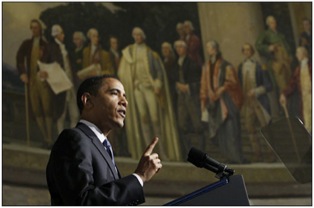
The last few days I have been very critical of Obama’s waffling on issues of national security. I have also allowed myself to become incredibly frustrated by the ridiculous, absurd, preposterous and shameful arguments that have come out of the some members of the press, some Republicans, and especially Dick Cheney (who is doing everything in his power to stay out of jail). So with a great sigh of relief, I just finished reading the transcript of Obama’s national security speech. His speech was not perfect (he did everything possible not to admit that both Guantanamo and enhanced interrogation were, above all else, illegal), and there were some moments of pure political spin (in particular on Afghanistan and Pakistan). Nevertheless, his words do reinforce our supposed self-image as a national of the rule of law.
Here are two excerpts from Obama’s speech that serve as additional arguments on why the problem is Guantanamo, not Obama’s policy to close it.
For over seven years, we have detained hundreds of people at Guantanamo. During that time, the system of Military Commissions at Guantanamo succeeded in convicting a grand total of three suspected terrorists. Let me repeat that: three convictions in over seven years. Instead of bringing terrorists to justice, efforts at prosecution met setbacks, cases lingered on, and in 2006 the Supreme Court invalidated the entire system. Meanwhile, over five hundred and twenty-five detainees were released from Guantanamo under the Bush Administration. Let me repeat that: two-thirds of the detainees were released before I took office and ordered the closure of Guantanamo.
. . . Indeed, the legal challenges that have sparked so much debate in recent weeks in Washington would be taking place whether or not I decided to close Guantanamo. For example, the court order to release seventeen Uighur detainees took place last fall – when George Bush was President. The Supreme Court that invalidated the system of prosecution at Guantanamo in 2006 was overwhelmingly appointed by Republican Presidents. In other words, the problem of what to do with Guantanamo detainees was not caused by my decision to close the facility; the problem exists because of the decision to open Guantanamo in the first place.
The president is definitely more articulate than I am on the issue.

The New York Times has just published a “news” story that once again shamefully manipulates the facts towards the absurd proposition that Guantanamo keeps us safe by failing in one in seven cases.
According to the Times, one in seven of the 534 Guantanamo prisoners already released have returned to the terrorist activities. Right off the bat, this claim is misleading. First the words “rejoin”, “return” and “recidivism”, all used in the article, give the false impression that the detainees were previously terrorists and captured on the battlefield. This is simply contrary to fact. One of the principle reasons they were released was because there was either no evidence or not sufficient evidence to convict them of any wrongdoing.
Next, the fact that one in seven Guantanamo detainees now engages in terrorism does not show that Guantanamo makes us safer. Quite the contrary. It is Guantanamo, a prison system that allows for the illegal detention of persons without sufficient evidence to convict them, that has produced this one in seven number; not the closing of the prison. So how does Guantanamo failing in one in seven cases due to it own inherent defects make us safer than an American supermax prison? Rather, wouldn’t those same defects continue to produce similar numbers?
Finally, the article completely ignores the mirror side of the same statistic: only one in seven of those 534 Guantanamo prisoners have proven to be potentially dangerous. That means that six in seven of those detainees were deprived of basic human rights for half a decade, subjected to Cheney’s enhanced interrogation program, yet pose no threat to the U.S. How does an 86% prisoner innocence rate make us more safe?
If anything, the statistics demonstrate how Guantanamo has failed in both making us safer and bringing terrorists to justice. Perpetuating Guantanamo only reinforces those failures. These same statistics in the American criminal justice system would be scandalous. Can you imagine a prosecutor repeatedly failing to try or convict criminal defendants held in detention for years — one in seven of which were dangerous, six of seven innocent — and politicians arguing that the prosecutor is the solution not the problem?
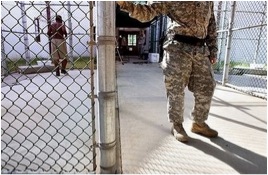
Many Republicans are celebrating with the old “I told you so” as Obama appears to be reversing some of his campaign promises and sticking to many Bush era national security policies. But don’t be confused. It’s not that Obama suddenly saw the light upon entering the White House. In fact, maintaining Bush’s policies do not make the country safer, but they do help keep the president in office. In other words, Obama’s decisions on everything from Guantanamo to Afghanistan are purely about political survival and have little to do with security, proving that even Obama caves under pressure. Continue reading
This article by Glen Greenwald in Salon.com, about the “preposterous” fear, in the words of George Will, that imprisoning terrorists makes up less safe, is a must read. Here’s a short excerpt:
The “debate” over all the bad and scary things that will happen if Obama closes Guantanamo and we then incarcerate those detainees in American prisons is so painfully stupid even by the standards of our political discourse that it’s hard to put into words, and it also perfectly illustrates the steps that typically lead to America’s National Security policies:
(1) Right-wing super-tough-guy warriors project some frightened, adolescent, neurotic fantasy onto the world — either because they are really petrified by it or because they want others to be (“Putting Muslim Terrorists in our prisons will make us Unsafe! — Keep them away from me, please!!!”);
(2) Rather than scoff at the inane fear-mongering or point out simple facts to reveal its idiocy, Democratic “leaders” such as Harry Reid echo the right-wing fears in order to prove how Serious and Tough they are — in our political debates, the more frightened one is, the more Serious and Tough one is — and/or because they are genuinely frightened of being called mean names by Sean Hannity (“Harry Reid isn’t as scared of this as I am, which shows that he’s weak”);
(3) “Journalists” who are capable of nothing other than mindlessly reciting what they hear then write articles depicting the Right’s frightened neurosis as a Serious argument, and then overnight, a consensus emerges: Democrats are in big trouble politically unless they show that they, too, are as deeply frightened as the Right is.

According to “Our Unending War” by Noam Chomsky, while I am allowed to find the last eight years “Shameful and Scary“, I mustn’t feign surprise, as the Bush Cheney modus operandi is just part of a long legacy of American torture and abuse. Continue reading

Two aspects of Spain’s democracy have always struck me as being contrary to the very principles of democratic governance: its questionable separation of powers and lack of political accountability.
The first of these is the lack of a clear separation of powers, especially between the executive and legislative branches of government, but also with respect to the powers delegated to the judicial branch. Perhaps this is in part due to the fact that Spain is a constitutional monarchy wherein the King is the ultimate head of state. Nevertheless, the basic functions of the executive branch, as assumed by the president and his ministries, are in practice inseparable from the majority rule of the legislature.
In other words, the president and the congressional majority are one and the same. Much of this is due to Spain’s system of electing its president and congressional representatives. Instead of voting to elect individual representatives for specific congressional seats, there is a single “presidential” election, and each party presents one presidential candidate plus a fixed, closed list of potential congressional representatives (for both the senate and the lower legislative chamber). Based on the pro-rata share of the votes, the congressional seats are allocated accordingly between each party, and the party with the majority of votes wins the presidency.
When the president takes office and assumes power, his cabinet members and ministers generally serve in the legislature as well. For example, Carme Chacón is both the Minister of Defense and a representative in congress. This same lack of a Chinese wall standing between the executive and legislative branches is also replicated at the regional level (i.e., Esperanza Aguirre, the president of the Madrid autonomous region is also a representative in Madrid’s legislature).
The immediate result is that the voice of the presidency and the legislature’s majority is one and the same, united and indivisible. Any disputes that could possibly arise within the ruling party are always settled in private; thus leading to a total lack of transparency or public inter-party debate. This inevitably leads to the alienation of local interests at the national level. There are two principle reasons for this: public differences on policies are strictly prohibited by the party, even though it is only logical that constituents from different regions will likely have differing political interests on any given matter (what’s good for one locality may not be good for another), and, as I will explain further below, the representatives are accountable to their party alone and not to their supposed constituents. Continue reading
Filed under Essays, Living la vida española

 Grave Error