The Fear of the Tough Guys

I find it increasingly incomprehensible how the hawks panic whenever terrorism crosses paths with the U.S. justice system, as if terrorism will always prevail. Just watch how David Brooks – everyday more of an extremist – views American justice as being incapable of handling terrorists and their propaganda:

I found [Holder’s decision to try the terrorists in court] disturbing, because the terrorists not only get to attack the country and make a global statement that way. Now they’re going to have a public trial to make more statements.

And potential future terrorists will also know that, if caught, they can have a trial, sort of an international reality TV show, to make their statements.

… I mean, what is terrorism? The real targets of a terrorist attack are not the people who are killed. It’s the message that is sent to the country, the act of intimidation. It’s the message of rallying radicals in other parts of the world. And that’s what terrorism is. That’s why terrorism is a unique form of warfare.

This trial will become another act of propaganda. The future trials will become other acts of propaganda. And I think we have to understand that terrorism works through propaganda, not through simply killing. And, therefore, controlling the propaganda effects of an act of terrorism seems to me part of the process we should adapt.

They should have the rights that they’re afforded by the Supreme Court and by the Constitution, but that doesn’t mean we need to provide them with another propaganda opportunity.

Would that mean that any trial whatsoever is potentially incompatible with our justice system? Wouldn’t prosecuting any high profile suspect, according to Brooks’ logic, be considered rewarding the criminal? Do we have that little faith in our Constitution and system of justice?

In his post, “The Right’s textbook ‘surrender to terrorists’: ‘We’re too scared to have real trials in our country’ is a level of cowardice unmatched in the world,” Greenwald notes

People in capitals all over the world have hosted trials of high-level terrorist suspects using their normal justice system.  They didn’t allow fear to drive them to build island-prisons or create special commissions to depart from their rules of justice.  Spain held an open trial in Madrid for the individuals accused of that country’s 2004 train bombings.  The British put those accused of perpetrating the London subway bombings on trial right in their normal courthouse in London.  Indonesia gave public trials using standard court procedures to the individuals who bombed a nightclub in Bali.  India used a Mumbai courtroom to try the sole surviving terrorist who participated in the 2008 massacre of hundreds of residents.  In Argentina, the Israelis captured Adolf Eichmann, one of the most notorious Nazi war criminals, and brought him to Jerusalem to stand trial for his crimes.

It’s only America’s Right that is too scared of the Terrorists — or which exploits the fears of their followers — to insist that no regular trials can be held and that “the safety and security of the American people” mean that we cannot even have them in our country to give them trials.  As usual, it’s the weakest and most frightened among us who rely on the most flamboyant, theatrical displays of “strength” and “courage” to hide what they really are.   Then again, this is the same political movement whose “leaders” — people like John Cornyn and Pat Roberts — cowardly insisted that we must ignore the Constitution in order to stay alive:  the exact antithesis of the core value on which the nation was founded.  Given that, it’s hardly surprising that they exude a level of fear of Terrorists that is unmatched virtually anywhere in the world.  It is, however, noteworthy that the position they advocate — it’s too scary to have normal trials in our country of Terrorists — is as pure a surrender to the Terrorists as it gets.

The real controversy here is whether these are mere show trials. We only try the cases we think we can win, while the rest of the detainees are to be kept in cages indefinitely without trial or anything resembling due process. That is the true test of our resolve to uphold the American Way.
Leave a comment

Filed under Essays, Obama 44

Changing Behavior

Of course, “fun” loses its novelty over time.

Thanks, Bill.

Leave a comment

Filed under Digressions

Could There Be Change on the Horizon?

This morning I was listening to veteran New Yorker investigative reporter, Seymour Hersh, on NPR’s Fresh Air, and Hersh addressed a leaked story that

President Obama has rejected the options for Afghanistan presented by his national security team, and instead is pushing for revisions to clarify how and when U.S. troops would turn over responsibility to the Afghan government. This follows leaked classified cables from Americas ambassador to Afghanistan, Karl Eikenberry, expressing his misgivings about sending in more troops.

I have been very critical of Obama – even after strongly advocating for his election – for his bold words and tepid actions that have done little more than institutionalize the status quo. Instead of change, we’ve seen more of the same. On the Afghanistan, Guantanamo, torture and use of the military, I have also slammed Obama for thinking strictly in political rather than policy terms – a trait characteristic of Democrats to feign military toughness.

I suppose what has bothered me the most about the Obama presidency is not that Obama has gone back on his campaign promises – that is what all politicians do – but that I know Obama knows better. I think he understands the issues, but is simply too much of a political wimp, a crowd pleaser, to stick to his guns.

Now this leak could be your run-of-the-mill Washington false leak (very Clintonesque) to test the waters. But if true, it would amount to an unprecedented change, real change, in how presidents make decisions on the use of our military. As Hersh explains (and I recommend you read the entire transcript),

Well, assuming that [the leak] is accurate, and it’s very early in the process, this could be an amazing – a really important step for the president, because I can tell you that many in your audience and obviously many here in Washington are very concerned about the fact that he delegated so much of the war-making policy to the generals in the field, asking General McChrystal, for example, to write the initial report on what to do in Afghanistan.

There isn’t a general in the Armed Forces asked to do that would say, I can’t win. That’s just what they do. So he put himself into a box, and he was very passive for a long time about it. And that’s why if you would ask me four days ago what I thought, I would have thought he’s going to make a political decision to do something with some token troops because he wants to he doesn’t want to lose more independence. He wants to show he can run a war. He can be a tough guy.

But what Obama’s done, if he has done what it seems he’s done, is if he’s telling the military, you know what? I don’t think it’s going to fly. This is huge because he’s basically saying I’m not going to play politics with the war. I’m not going to do what other president’s have and continue a war and continue fighting a war that I don’t think we can win – just only for the time, until I can find a way out. That’s what I would have guessed three or four days ago, he was going to do. He was going to wait for the political, right political moment when the public was so discouraged about the war, you could actually end it in some way. Instead, he’s saying, I’m going to stand up and be president, take my chances in 2012 on reelection.

He’s really doing – if he’s doing what’s been reported – a pretty noble thing. The problem is – and this is a daunting problem. The problem is I don’t think there’s any way you can stand up the – the Afghan army. The army traditionally has been controlled by Tajiks and Uzbek, from people from Uzbekistan – you know, from those Northern Alliance, we call them, in Afghanistan.

The Pashtuns who would be controlled by this army, theoretically, under the American dream, there’s no way they’re going to view Uzbeki or they’re going to view them as much of an outsider as they would view the Americans. They simply don’t like others in their face.

On a related note, one thing we hardly hear discussed in the debate on troop escalation is the fact that we simply do not have enough troops. On McChrystal’s proposal for 40,000 more troopos, Hersh says, Continue reading

5 Comments

Filed under Essays, Obama 44

America’s Defining Choice

ts-kristof-190.jpg

As Borja has noted, I have recently been quiet on the health care front. In part this is due to suffering from kidney stones this past month and consequently focusing more on Spain’s health care system than the joke of a debate going on back in the States. Needless to say (as I have already written countless times before), I am in favor of a public option – not that I would necessarily contract the public option myself, but a public option would without a doubt drive down costs and make the private alternatives – as is the case in Spain – more affordable and accessible.

For non-Americans the entire notion that somehow Americans could be against universal, affordable health care is mind-boggling. Yet, it is true. Many Americans have this perverse – albeit factually inaccurate – idea that any government sponsored program amounts to communism. Americans tend to ignore the fact that many activities so representative of Americana, that set us apart from the rest of the world, are in fact government-run or publicly sponsored.

A few months ago I had conversations with various friends who had grown up in the United States but were now raising children in Europe, some were Americans others were Spanish. They all mentioned access to public sports as what their children would most miss out on by growing up outside of the U.S. That’s right, good old fashioned American little league baseball, recreational soccer, and the local basketball courts are all public.

Does that mean that our kids are commies because they take the yellow bus to their public elementary school? Are our local high school cheerleaders socialists because their uniforms are paid for by the tax payer? When they put lights up at the public high school’s football stadium are we turning into Communist China?

Ironically, many conservatives argue that the solution is to be found in … you guessed it, government regulation (what they euphemistically call “Tort Reform”). Let’s leave this topic for a separate post, but suffice it to say that the costs associated with malpractice lawsuits only represent about two percent of the total cost of health care and have been stable since the 1980s.

Besides the silly ideological battle from the right, the pharmaceutical and health insurance lobbies have the guys on the left in their pockets, insuring that there will be no real or meaningful reform. This translates once again into the difference between Obama’s bold words and his subsequent blandness. The result will most likely be a public mandate and not a public option. In other words, health care will be like auto-insurance; everyone will be required to buy insurance from … you guessed it, the big winners, the insurance companies.

For the time being, though, I will defer to New York Times columnist Nicolas D. Kristof’s two recent articles on the subject. The first one debunks that myth, popular in the U.S., that we have the best health care system in the world:

The United States ranks 31st in life expectancy (tied with Kuwait and Chile), according to the latest World Health Organization figures. We rank 37th in infant mortality (partly because of many premature births) and 34th in maternal mortality. A child in the United States is two-and-a-half times as likely to die by age 5 as in Singapore or Sweden, and an American woman is 11 times as likely to die in childbirth as a woman in Ireland.

. . . Opponents of reform assert that the wretched statistics in the United States are simply a consequence of unhealthy lifestyles and a diverse population with pockets of poverty. It’s true that America suffers more from obesity than other countries. But McKinsey found that over all, the disease burden in Europe is higher than in the United States, probably because Americans smoke less and because the American population is younger.

Moreover, there is one American health statistic that is strikingly above average: life expectancy for Americans who have already reached the age of 65. At that point, they can expect to live longer than the average in industrialized countries. That’s because Americans above age 65 actually have universal health care coverage: Medicare. Suddenly, a diverse population with pockets of poverty is no longer such a drawback.

The second addresses whether it is better to be spending on health care or Afghanistan:

President Obama and Congress will soon make defining choices about health care and troops for Afghanistan.

These two choices have something in common — each has a bill of around $100 billion per year. So one question is whether we’re better off spending that money blowing up things in Helmand Province or building up things in America.

With a war that has almost no effect whatsoever on keeping us safe at home, I would rather have a normal first world health care system.

2 Comments

Filed under Essays, Obama 44

No Faith In Justice

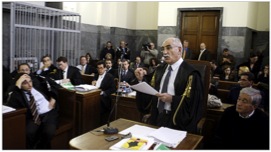
italian-judge.jpg

The New York Times’ editorial board today writes about the stark contrast between two court decisions on extraordinary rendition:

Two courts, one in Italy and one in the United States, ruled recently on the Bush administration’s practice of extraordinary rendition, which is the kidnapping of people and sending them to other countries for interrogation — and torture. The Italian court got it right. The American court got it miserably wrong.

In Italy, a judge ruled that a station chief for the Central Intelligence Agency and 22 other Americans broke the law in the 2003 abduction of Osama Moustafa Hassan Nasr, a Muslim cleric who ended up in Egypt, where he said he was tortured.

Two days earlier, a federal appeals court in Manhattan brushed off a lawsuit by Maher Arar, a Syrian-born Canadian citizen who was seized in an American airport by federal agents acting on bad information from Canadian officials. He was held incommunicado and harshly interrogated before being sent to Syria, where he was tortured. He spent almost a year in a grave-size underground cell before the Syrians let him go.

The United States Court of Appeals for the Second Circuit decided that none of that entitled Mr. Arar to a day in court.

In Mr. Nasr’s case, authorities said that they had reason to suspect he was involved in recruiting militants to go to Iraq. It has long been established that Mr. Arar was not guilty of anything. Canada admitted that it had supplied false information to American authorities, and in 2007, it apologized and offered Mr. Arar $10 million in damages. Neither the Bush nor Obama administrations followed suit, leaving Mr. Arar to pursue litigation.

In June 2008, a three-judge panel of the same court dismissed Mr. Arar’s civil rights suit on flimsy grounds. The court then took a rare step, scheduling a rehearing before all of the court’s active members before an appeal was filed. Sadly, the full court’s decision is even more insensitive to the violation of his rights and the courts’ duty to hold government accountable for breaches of the law.

Written by Chief Judge Dennis Jacobs, the 59-page majority opinion held that no civil damages remedy exists for the horrors visited on Mr. Arar. To “decide how to implement extraordinary rendition,” he wrote, is “for the elected members of Congress — and not for us as judges.” Allowing suits against policy makers for rendition and torture would “affect diplomacy, foreign policy and the security of the nation,” Judge Jacobs said.

The ruling distorts precedent and the Constitutional separation of powers to deny justice to Mr. Arar and give officials a pass for egregious misconduct. The overt disregard for the central role of judges in policing executive branch excesses has frightening implications for safeguarding civil liberties, as four judges suggested in dissenting opinions.

It is painful to recall that this is the same federal circuit court that declared in 1980 that even foreigners accused of torture in foreign countries can be called to account in American courts. The torturer is the “enemy of all mankind,” the Court of Appeals for the Second Circuit declared back then. One of the dissenters, Judge Guido Calabresi, said that “when the history of this distinguished court is written, today’s majority decision will be viewed with dismay.”

The damage to Mr. Arar, America’s reputation and the rule of law is already quite plain. The Supreme Court should reverse this ruling

[Emphasis added]

Forget for a moment that both these cases raise alarming questions about inchoate crimes for terrorist suspects (when do we decide a person is a criminal based on his potential for committing future crimes long before a crime has actually been committed?).

What is most striking about these cases is that they show a gross disregard for and lack of confidence in the judicial systems of democratic states. For example, in the Italian case, the CIA unilaterally decided that it was better to have Osama Moustafa Hassan Nasr tortured in Egypt than arrested and prosecuted in Italy. And in Mr. Arar’s case, the CIA – now with the deference of the Second Circuit – once again affirmed that total lack of faith in the American justice system for enforcing and prosecuting the law. So what are we trying to establish in countries like Iraq and Afghanistan? A Jeffersonian legislative democracy with an Egyptian and Syrian judicial system?

8 Comments

Filed under Essays

There Will Be Blood (II)

fight-on.jpg

In light of the recent Fort Hood shooting and the debate on whether to increase troop levels in Afghanistan, it is interesting to note the obvious: fighting “terrorism” in Afghanistan has absolutely no effect whatsoever on the ability of any crazy person or groups of crazy people to perpetrate heinous acts within the U.S.  Had we already been fighting in Afghanistan pre-911 (before the Patriot Act, domestic surveillance of emails and phone calls, extraordinary rendition, black sites, Guantanamo, torture, drones, and countless civilian collateral damage), we would not have prevented the worst terrorist attack in U.S. history, nor the Madrid bombings, nor the ones in London.

And yet, we fight on. There will be blood. Americans demand it, somewhere, anywhere, to whomever. Just far away from home.

2 Comments

Filed under Essays

When Extremism is Not Terrorism

I just read two interesting articles from two different sides of the political spectrum, surprisingly both in agreement, on why the Fort Hood shooting was not, by definition, terrorism.

According to the National Review’s Jonah Goldberg (with subsequent update),

Terrorism is, by conventional definition, an attack on civilians intended to strike fear in the non-military population in order to advance a political or ideological agenda. Hasan didn’t attack civilians, he attacked uniformed members of the U.S. Army in advance of their deployment to the frontlines. It was an evil act, but was it an act of terrorism?

The progressive Glenn Greenwald explains the problem with using a more expansive definition of terrorism:

But if one accepts that broadened definition of “terrorism” — that it includes violence that targets not only civilians but also combatants who are unarmed or not engaged in combat at the time of the attack — it seems impossible to exclude from that term many of the acts in which the U.S. and our allies routinely engage.  Indeed, a large part of our “war” strategy is to kill people we deem to be “terrorists” or “combatants” without regard to whether they’re armed or engaged in hostilities at the moment we kill them.  Isn’t that exactly what we do when we use drone attacks in Pakistan?  Indeed, we currently have a “hit list” of individuals we intend to murder in Afghanistan on sight based on our suspicion that they’re involved in the drug trade and thus help fund the Taliban.  During its war in Gaza, Israel targeted police stations and, with one strike, killed 40 police trainees while in a parade, and then justified that by claiming police recruits were legitimate targets — even though they weren’t engaged in hostilities at the time — because of their nexus to Hamas (even though the Israeli human rights group B’Tselem said the targeted recruits “were being trained in first aid, human rights and maintaining public order”).

And on this point, incredibly, Goldberg agrees:

In Pakistan, we launch missiles at people’s homes with civilians in or around them to take out al-Qaeda leadership. The attacks are — hopefully — always intended to be something of a surprise. But I wouldn’t call that terrorism. I’m just uncomfortable with the word terrorism metastasizing into “anything the bad guys do to us.” Why not call what Hasan did a war crime? Terrorism is a war crime but not all war crimes are terrorism.

On another note, during World War II, we interned Japanese Americans because their ethnicity alone made them suspicious. It will be interesting to see how the U.S. deals with Hispanic Americans (now roughly fifteen percent of the population) if we someday invade a Latin American country. When will Hispanic Americans disagreeing with U.S. policy be considered sympathetic towards or suspicious of terrorism? With such a large portion of our military personnel being Hispanic, that’s a lot of screening.

7 Comments

Filed under Essays

Is David Brooks Making My Point?

There are voices in the past few days, mainly from the far right, that are blaming “political correctness” for not promptly linking the Fort Hood shooting by a Muslim American to Islamic extremism.  As I have already argued, we always come up with some inane excuse to push under the rug the All American shooting spree.

In today’s New York Times, David Brooksthe soft spoken, moderate conservative yet unapologetic war-monger – seems to come up with the same conclusion even though he is trying to blame the shooting on Islamic extremism. He writes,

This narrative [of Islamic violence] is embraced by a small minority. But it has caused incredible amounts of suffering within the Muslim world, in Israel, in the U.S. and elsewhere. With their suicide bombings and terrorist acts, adherents to this narrative have made themselves central to global politics. They are the ones who go into crowded rooms, shout “Allahu akbar,” or “God is great,” and then start murdering. [Emphasis added]

Get rid of the “God is Great” part and what should we call that varied class of Americans who regularly do the exact the same? Brooks could be speaking about Americans. He continues,

The conversation in the first few days after the massacre was well intentioned, but it suggested a willful flight from reality. It ignored the fact that the war narrative of the struggle against Islam is the central feature of American foreign policy. It ignored the fact that this narrative can be embraced by a self-radicalizing individual in the U.S. as much as by groups in Tehran, Gaza or Kandahar.

It denied, before the evidence was in, the possibility of evil. It sought to reduce a heinous act to social maladjustment. It wasn’t the reaction of a morally or politically serious nation. [Emphasis added]

Brooks has made my point. We always reduce the heinous act of the great American shooting spree to social maladjustment. We talk, just as we did here, about early warning signs, but we never seriously discuss why going postal is such a frequent occurrence in American life or why we allow people such easy access to deadly weapons. Addressing our gun laws or questioning our character would be “political incorrect” and put our exceptionalism into question.

So, Mr. Brooks, when have we ever reacted after shooting spree as a “morally or politically serious nation”?

Finally, it would be ironic if it takes a Muslim American acting like an All American to finally change the way the pro-gun absolutists view easy, quick and unhindered access to weapons. The argument, as used after the Virgina Tech shooting, that more guns will protect us from guns doesn’t hold weight when the shooting occurs on the largest military base of the most militarized nation on the planet.

2 Comments

Filed under Essays

Going Postal and Apple Pie

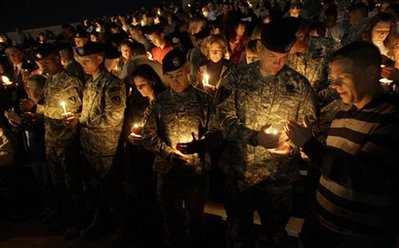
fort-hood.jpg

Another shooting spree, it’s become such an internationally recognized trademark of American culture that we should now say “as American as Apple Pie Going Postal.”

In this sense, the New York Times is correct in saying that we should not jump to conclusions about this week’s shooting at Ford Hood,

It is always a shock — and a cause for deep sadness — when a gunman fires malevolently at crowds of innocent people. We have seen it far too often: at Columbine High School in Colorado a decade ago; on the campus of Virginia Tech two years ago; at a center for immigrants in upstate New York in April; and in downtown Orlando, Fla., where a gunman shot and killed one person and wounded five others on Friday.

We always come up with a scapegoat to avoid pointing the finger at the violent, dysfunctional character of American society that produces and reproduces these tragic episodes. The fact that Major Nidal Malik Hasan was a Muslim American is no exception; it just gives us another easy excuse to avoid looking in the mirror. Remember how after Columbine the Republicans wanted legislation to publish the Ten Commandments in all high schools so students would know that killing was wrong? As if that were the root of the problem or even remotely constitutional.

Now it must be Islam or terrorism (it was insanity, not religion or ideology, when a right-wing Christian shot up the Holocaust Museum earlier this year). Ironically, it could take a Muslim American adopting the All American modus operandi for us to finally recognize that going postal is a our own homegrown, domestic breed of terrorism, committed by Americans of all stripes.

2 Comments

Filed under Essays

On Nation Building

good_the_bad_and_the_ugly_poster.jpg

Regardless of what many of us think and the vision of our beloved Founding Fathers, it took the United States over a century to become a stable democracy. According to Rory Stewart, in the best of scenarios, Afghanistan can aspire to have the democracy of Pakistan in thirty years. In eight years, American tax payers have already shelled out $220 billion. Only 92 years to go.

2 Comments

Filed under Essays, Obama 44