
My favorite dish. With my mother and grandmother on the other side of the ocean, I resort to my own means.
My favorite dish. With my mother and grandmother on the other side of the ocean, I resort to my own means.
Filed under Digressions, Friends / Family

During the first two years of the war in Iraq, my neighbor sported a large banner on his balcony that read “No a la Guerra” or “No to War”. Then last January he hung a flag of the pro-Sahrawi (Algerian and Libyan backed) Polisario, in favor of Western Sahara’s independence from Morocco. And over the past few days following the recent disturbances in the region between the Polisario and the Moroccan government, he has decided to once again hang the Polisario flag.
What I find interesting is that a person — not to mention the whole gang of self-righteous Spanish actors — who was so vehemently against one war in an Arab country when the American right claimed to be toppling a human rights abusing dictatorship is now so eager to favor another war in an Arab country, but this time with the difference that it is the Spanish left who gets to denounce a human rights abusing dictatorship. I suppose in retrospect the original slogan should have read “No a Esta Guerra” instead of the moral condemnation of war of in general.
If anything, what we learned from Iraq is that the world becomes a very wicked place when people so confidently and self-righteously believe that they have the truth on their side.
Filed under Essays, Living la vida española

I had some time to waste this evening and feeling too lazy to read, I opted for the option of least resistance: to watch Meet the Press after pretty much having boycotted it all year for its incredibly low caliber breadth and total lack of intellectual rigor. I fast-forwarded past the David the Puppet Axelrod until landing on planet John McCain. The ever-unintelligible and increasingly incoherent John McCain in response to a question about his presence at the infamous October 2008 White House meeting to discuss the economic crisis – the one you may recall he suspended his campaign to urgently attend to – stated that he had gone to the White House only because he wanted the Republicans to be represented at the meeting. He might have forgotten that at the time the White House was Republican. As you can imagine, I immediately moved on.
Then I got to the round table made up of Alan Greenspan, Newt Gingrich, and Harold Ford, Jr. on the state of the economy; in other words, three people who have been consistently wrong about everything related to fiscal and monetary policy for the past two decades. As always, Mr. Soft Ball was the host, and as you can imagine, all of the panelists – including a forth one who had recently written a book about the crisis – all agreed on almost everything, namely that we are on the verge of a devastating debt crisis that requires immediate action. There was no evidence presented, no science, no math, not a single expert – unless you don’t considered Mr. Greenspan discredited yet. Just a bunch of guys who always and have always gotten it wrong.
Forget for a second that nobody cares about the deficit other than the politicians, that the worst thing for the economy would be to take more money out of circulation by cutting spending, or that absolutely everything that New Gingrich ever says is an absolute fabrication and that no one on Meet the Press ever calls him on it, but why is the bi-partisan logic that has failed us for almost three decades and has turned us into a banana republic continuing to prevail? If the deficit were so important, why would we increase it by 300 billion just to reward the wealthiest Americans with tax relief they don’t need? Gingrich might not remember this, but it wasn’t the average citizen that decided to invade two countries for decade long wars while lowering taxes and not paying for either. It wasn’t the average citizen who toppled the economy through misfeasance and corrupt practices. So why should the only solution ever be to make the citizens pay? Why should we have our services cut so that the wealthiest at the very top (who can afford to live without public services) and corporations can reap all of the benefits? Because the money will trickle down? How has that worked for us over the past 30 years? Answer: Banana Republic.
Special thanks to Meet the Press for making life easier for the politicians and the status quo. And instead of a leisurely Sunday evening spent on what could have been an interesting political discussion, I’ve gotten to waste it on this post.
Update: I just read that Social Security accounts for only five percent of the economy. Regardless of the fact that “making the Bush tax cuts for the wealthy permanent is a huge budget issue — over the next 75 years it would cost as much as the entire Social Security shortfall,” yet cutting Social Security is still considered by the serious players as the key area of concern while continuing the tax cuts is a welcome compromise.
Filed under Essays
On November 6, 1975 in what is known as the Green March, 350,00 Moroccans peacefully protested in southern Morocco to demand that the Spanish government handover the Spanish Sahara to Morocco – reinforcing the notion that peaceful resistance is more effective than other alternatives.
Thirty-five years later this week and some sectors of the Spanish press and mainly left-leaning activists still have a strange passion for intervening in the region. As I have mentioned in previous posts – regardless of where one may stand on the independence of Western Sahara – it is strange that the Spanish left would take such an active position in favor of the Algerian and Libyan financed Frente Polisario considering that Spanish intrigue continues to have strong imperialistic overtones for the Moroccan people.
For an example of how the Moroccans see the liberation from Spanish colonialism – done through peaceful protest – as a proud and heroic moment of the triumph of the People against the Imperialists, check out the above video of the song “Laayoune Iniya” from the early 70s by Jil Jilala, a group that pioneered a new generation of grass roots folk musicians widely popular at the time amongst European and American granola hipsters. The song, meaning “Laayoune, my eyes” (a play on words as the city name “Laayoune” is derived from the same root as the word “eyes” and “springs”) became the anthem for the Green March and the liberation of the last remaining vestiges of European colonialism in Morocco.
And yet here they are, the Spanish granola hipsters of today, thirty-five years later, coming off as the Spanish imperialists redux.
Filed under Essays, Living la vida española

I suppose it isn’t news that former President Bush arrogantly broke the law during his tenure in the White House, so it shouldn’t be news when he now admits with great bravado to having broken the law by personally giving the order to torture terrorist suspects.
As is so typical in our political culture chock full of politicians and journalists (the Cheney’s, Bush’s, Friedman’s and Brooks’ of the world) who worship warfare without ever themselves setting foot on a battlefield, how truly cynical for W. to pretend that he was tough enough to break the law to protect America when he never intended – nor will he ever be expected – to be held accountable for his actions.
And when Bush says that he would “make the same call again”, does he mean with the same legal risks for himself? Where is the courage if you didn’t even have to take one for the team?
Obama’s policy of “Look Forward, Not Backward” will assure that Obama too will be granted the same privilege of faux bravery and patriotism.
Isn’t it good to be the King?
Filed under Essays

Last weekend I took my twentieth flight to Paris this year. While the back and forth gets tiring — and hopefully will be resolved soon — the colors of autumn, so prevalent in Paris and so absent in Madrid, reminded me of just how much I miss this time of year back at home.
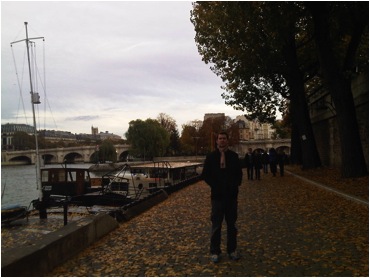
Unfortunately, I also started seeing the first hints of the impending Christmas shopping season, and knowing that this year I won’t be home for Christmas (something I will write about soon), opens a whole other box of worms.
Filed under Digressions
Should you have the time, I recommend you watch Glenn Greenwald discussing the state of civil liberties in the Age of Obama and why the civil liberties indoctrinated in the Constitution (and the American consciousness) were specifically crafted to be taken in the extreme, not with a grain of salt.

On an unrelated note, I know what morcilla is and I know what lengua is. And even though I see the two words together almost every day at lunchtime, I am not quite sure whether I really want to do the math and figure out what morcilla de lengua is.
Filed under Living la vida española

Don’t mean to say I told you so, but I predicted on the day before Obama won the election in November 2008 that Republicans would have a big victory in the November 2010 midterms. Regardless of the fact that the Obama administration has been a showcase for conventional, status quo continuity of presidents past or that the economic meltdown and government intervention happened on Republicans’ watch – as Frank Rich recently wrote,
when Mitch McConnell appeared on ABC’s “This Week” last month, he typically railed against the “extreme” government of “the last year and a half,” citing its takeover of banks as his first example. That this was utter fiction — the takeover took place two years ago, before Obama was president, with — went unchallenged by his questioner, Christiane Amanpour, and probably by many viewers inured to this big lie.
— reality aside, we are just so incredibly predictable as voters.

I have been watching the French Canal+ film series, Carlos, about Carlos the Jackal, and was thinking about how the golden age of terrorist hijacking that took place in the late 60s and throughout the 70s really had nothing to do with Islam. As a matter of fact – regardless of what Misters Williams and O’Reilly may believe – those terrorist pioneers were led by Arab Christians and a motley crew of international Marxists, all of whom were dressed more like Starsky and Hutch than like Garbed Muslims.
A simple googling of the two leaders of the Popular Front for the Liberation of Palestinians, George Habash and Wadie Haddad, and I was surprised to find that Time – a publication targeting the eight year old audience – had actually written an obituary of George Habash that recognized the Christian and non-Muslim origins of Middle Eastern terrorism. Entitled “Terrorism’s Christian Godfather”, the article reads,
You could call George Habash, a Palestinian leader who died in Amman on Saturday at the age of 82, the godfather of Middle East terrorism. If you assumed that Palestinian or Arab extremism somehow sprung entirely from Islam — from the puritanical Wahabbi intolerance and so forth — take a close look at Habash’s first name. He was a Greek Orthodox Christian, who sang in his church choir as a boy back in the Palestinian town of Lydda. Habash’s life tells us a lot about the long Israeli-Palestinian conflict, which seems as intractable as ever, and prompts reflection on the Middle East’s seemingly unstoppable whirlwind of violence.
Habash’s group, the Popular Front for the Liberation of Palestine (PFLP), pioneered the hijacking of airplanes as a Middle East terror tactic — one eventually employed by the al-Qaeda hijackers on 9/11 — way back in 1968 when three PFLP armed operatives commandeered an Israeli El Al airliner enroute from Rome to Tel Aviv. Checking in for a flight has never been the same since.
This isn’t to say that there is something inherently Christian at the root of Middle Eastern terrorism. These terrorists, including their international brothers in arms, were part of the post-World War II fall out – either political ideologues caught up in what they perceived to be oppressive capitalist imperialism or those Pan Arabists who fought against the occupation of Palestine. As history would prove, neither caught any traction, and just as the Marxists in Latin America lost their steam towards the end of the 80s, so did Pan Arabism, the latter to be replaced by religious –rather than ethnic – identity. In other words, it wasn’t until the Habashs and Jackals of the era failed that the Jihadists arose to fill the void.
In the very recommendable “It’s the Occupation, Stupid” in Foreign Policy, Robert A. Pape describes how occupation, rather than religion, is at the root of suicide terrorism.
In the decade since 9/11, the United States has conquered and occupied two large Muslim countries (Afghanistan and Iraq), compelled a huge Muslim army to root out a terrorist sanctuary (Pakistan), deployed thousands of Special Forces troops to numerous Muslim countries (Yemen, Somalia, Sudan, etc.), imprisoned hundreds of Muslims without recourse, and waged a massive war of ideas involving Muslim clerics to denounce violence and new institutions to bring Western norms to Muslim countries. Yet Americans still seem strangely mystified as to why some Muslims might be angry about this situation. Continue reading

 Grave Error