My Racist Tea Pot

Ever since last New Years Eve when my uncle-in-law, Brahim, prepared his special Moroccan tea, desert style (plenty of sugar, but no mint), I have been hooked. As a matter of fact, I much prefer this to the type of tea, which is actually much easier to prepare, than the more well know one with mint. All you need is gunpowder tea (a type of green tea imported by Moroccans from China), loads of sugar and a good dentist.

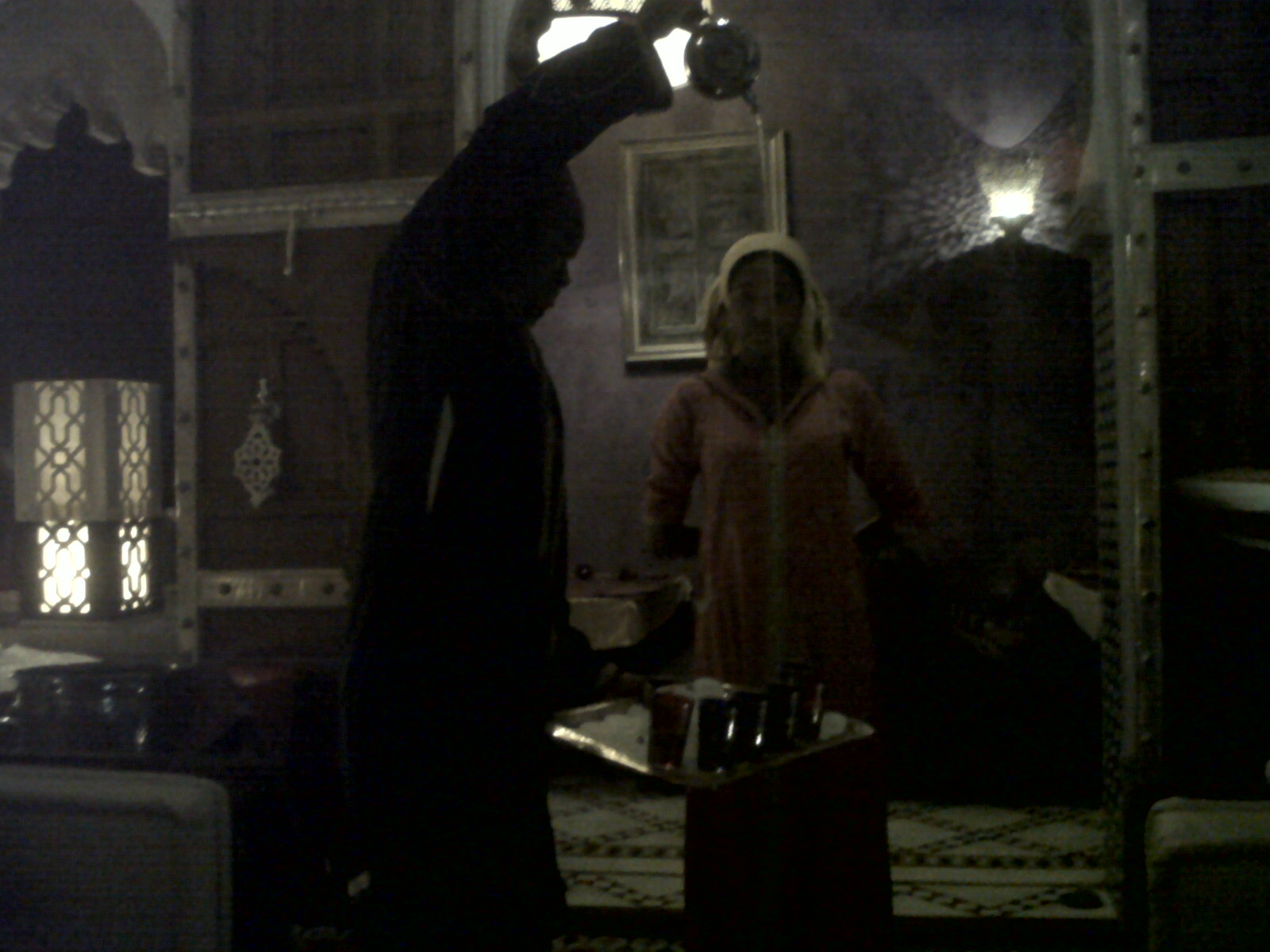
Another nice thing about Moroccan tea is that you get to serve it with fanfare from an elegant teapot into colorful glass cups. One of the problems, though, with a Moroccan tea set is that the pot can get too hot pour. Thus, the typical solution is to buy a cloth sleeve to go over the handle which you can readily find in the medina. Beware, this has its own pitfall.

Now one of my basic rules of blogging and tweeting is that I try as best as I can to stick to only criticizing my own country and society (of which I include Spain where I pay my taxes and have lived for more than a decade). Thus, please don’t take what I will say now as a critique but rather as a simply observation:

In Moroccan culture, the archetypical depiction of being served tea is that it is being served by a black (Moroccan) man. I can’t say much about racism or the racial breakdown of the present Moroccan population. Moroccans tend to be Arab, Berber (hailing from one of three different Berber groups), sub-Saharan African, or any mixture of all of these.  My understanding is that black Moroccans’ ancestors would have come to Morocco as slaves and served either the royalty or very wealthy families; though I imagine that many of the black people in Morocco today have roots in more contemporary immigration. Needless to say, slavery was officially banned in Moroccan with the arrival of the French in 1916, though I have no idea when it ended in practical terms.

In any event, black Moroccans were then associated with the Royal Palace where they lived and served. One of the ways this has translated into popular culture is that on television and in upscale restaurants, you’ll always see that the man serving the tea (in ceremonial cap and fez) is black. Not only that, almost every tea pot holder you find — including the one I use — will be fashioned as a black man pouring your tea. In my country, that would be just so wrong.

I love my Moroccan tea, which I limit to weekends; though as an American I do feel a little ashamed of myself each time I pour a glass.

1 Comment

Filed under Digressions, Married to a Moroccan

The Vicious Cycle of American Meritocracy

It’s interesting that at a time when American corporations and the wealthiest in the country are being taxed at rates that are lower than at any other time during the last 100 years, one of the major political parties is trying to convince Americans that if we do not lower taxes even further on these players, then they will cease to do us the honor of creating the wealth that our nation desperately needs. Now despite that this is simply factual nonsense (during the largest periods of growth during the last century corporations and wealthy citizens, including Mr. Romney Sr., co-existed with a much higher tax burden), this makes no psychological sense. The drive to make money and to succeed, even at the top, is not that tax sensitive. Our wealthiest citizens are not going to suddenly elect poverty because they have to pay the taxes of their fathers. As mentioned, higher taxes during the 1950 and 60s and during Reagan and Clinton didn’t stop the rich Americans from becoming rich.

But one of the biggest problems our nation faces is a psychological disorder, a vicious self-fulfilling prophecy, where people are so convinced that their success and/or failure is due to their own merit, that they are completely disconnected from reality. This inevitably leads to a continuous cycle of nepotism, where those who merit success are limited to those who already belong to the club of the elite, while those who do not belong repeatedly fail, and said failure denies them the merit to achieve success.

In other words, where a society so values success and almost blindly believes that success is solely attributed to one’s own merit, anyone who is successful or unsuccessful is presumed to deserve their station in society, and society is completely and unquestionable content with and accepting of the consequences of having people who succeed disproportionately and those who fail miserably. So for example, we are fully capable of accepting that a corporation can outsource (don’t say “offshore”) jobs and slash employee salaries while increasing executive pay to amounts that simply do not coincide in any shape or form with the reality of the executive’s performance. Yet this disconnect is disregarded, ignored. The CEO achieved the American dream because he [must have] worked harder than all those salaried employees. Continue reading

Leave a comment

Filed under Elections 2012, Essays

The Clash of Civilizations: Between American Geo-Politics and American Ideology

This morning on the metro I was listening to a Leonard Lopate Show podcast where Leonard interviews Fredrik Logevall on his new book Embers of War: The Fall of an Empire and the Making of America’s Vietnam. What struck me as interesting was how Logevall described Ho Chi Min’s travels to New York and Boston, his great admiration for the U.S., and how his fierce anti-colonialism was inspired by the Declaration of Independence. As a matter of fact, most anti-colonialist movements after World War II were inspired by America’s independence, yet ironically, the U.S. was at the time, and continues to be to this day, staunchly pro-colonialist.

Logevall attributes the U.S.’s choice immediately after the World War II to side with French colonialism in Vietnam against independence not so much to the fear of the spread of communism, but for its desire to have a strong France strike a power balance across Europe.

Whether or not the same is also true for North Africa and the Middle East, the U.S. consciously choice to support colonialism, neo-colonialism (the replacement of a foreign power with an internal regime that treats its own country as if it were a colony), and right-wing dictatorships over populist, secular and pro-democracy movements in the name of fighting communism.

Morocco is a perfect example. After having suffered a generation of French and Spanish imperialism, when the U.S. troops arrived on Moroccan coasts, the contrast was striking (as Fatima Mernissi describes nicely in Dreams of Trespass). The American soldiers were clean, kind and respectful, unlike their European counterparts. After the War and prior to independence, when grassroots, pro-democracy groups were forming, armed with American democratic values, the U.S. government chose the French. And after Morocco achieved its independence some 10 years later, the U.S. government then chose the monarchy. It was better to have a dictatorship you could finance and military bases where you could park artillery than the threat that free elections posed: labor unions, socialism, dominoes falling.

Does this sounds familiar? Continue reading

Leave a comment

Filed under Essays, We The People

Recent Good Reads

I am now subscribed to Good Reads, an online resource for tracking and sharing what you’ve been reading. It helps to remind me of what I have read, especially since I have moved to mainly reading on my Kindle, which has the major defect of not leaving a physical trophy on the book shelf to impress my friends with. This is my Good Reads list, and below is what I have read recently:

Each was good in its own way, but I would say that the biggest highlights were State of Wonder and A Life Full of Holes (and Skippy Dies if it weren’t so long winded).

And here are some of the titles on my Kindle waiting for a chance to be read:

Why so many classics, you may ask? They’re easy to find for free on the net.

I should also mention that I have uploaded song lyrics onto my Kindle as a cheat sheet for when I sing my son to sleep at night.

1 Comment

Filed under Literature

War as American Entertainment

On Monday I was reading via Glenn Greenwald about NBC’s new military-meets-celebs reality show and how

Nine Nobel peace laureates have called on NBC to cancel this show, pointing out that “war isn’t entertainment” and “people—military and civilians—die in ways that are anything but entertaining,” adding: “Trying to somehow sanitize war by likening it to an athletic competition further calls into question the morality and ethics of linking the military anywhere with the entertainment industry in barely veiled efforts to make war and its multitudinous costs more palatable to the public.”

This got me back to my early posts on how we really are becoming more and more like a page out The Hunger Games every day.

Then yesterday afternoon I finally got around to starting Kurt Vonnegut’s classic Slaughterhouse Five and read,

[In response to the narrator writing a novel about his experience in World War II] Well, I know,” she said. “You’ll pretend you were men instead of babies, and you’ll be played in the movies by Frank Sinatra and John Wayne or some of the other glamorous, war-loving dirty old men. And war will look just wonderful, so we’ll have a lot more of them. And they’ll be fought by babies like the babies upstairs.”

So maybe we’re not suddenly becoming more like The Hunger Games, but have for a long time worshipped War as the ultimate heroic sport. Think about it. What other nation constantly produces year after year blockbusters centered around the victorious combatants? Arguably only the Chinese and Japanese have anything remotely comparable in their cultures. Meanwhile we continuously label other religions and cultures – who have absolutely no traces of violence in their popular entertainment — as innately murderous; this, of course, serving the purpose of perpetuating our own ongoing thirst for even more entertainment.

1 Comment

Filed under Essays, Literature

Migrating to Graveerror.wordpress.com

graveerror-wordpress.jpg

If you haven’t noticed, Grave Error has moved to graveerror.wordpress.com

We are still working on migrating all of the content from this site to the new one, and time will tell what final URL we will end up using. We’ll keep you posted.

In the meantime, you can follow us at graveerror.wordpress.com and enjoy the new look and feel.

2 Comments

Filed under Digressions

Propaganda Straight from the Hunger Games

Last month I wrote about Americans’ fascination with The Hunger Games and the cognitive dissonance between their love of the freedom fighting heroin in the book and their adoration of authority in real life.

Now after reading Glen Greenwald’s recent “Leon Panetta: macho Renaisance man” on 60Minutes‘ full-on propaganda campaign in favor of the White House’s war machine disguised as journalism, I was immediately reminded again of The Hunger Games. How can Americans, so enamored with Ms. Katniss, watch that 60Minutes segment and not immediately see clear as day that their beloved trilogy is a direct criticism of the times we are living in today. Pelley is playing the role of Caesar Flickerman in pure, unapologetic and unfettered government propaganda.

And here we are all licking it up. We get to believe we love freedom and hate totalitarianism, all while worshiping our pseudo-soldier-rulers at the same time.

1 Comment

Filed under Essays, Literature, Obama 44

Coincidence or Irony?

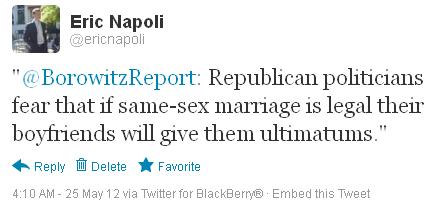
Three days ago I retweeted the above from @BorowitzReport.

It got me to thinking: why is it that, after all of the years I have lived in and gone home to visit my native Washington, DC, of all of the lobbyists I have known on Capitol Hill, I have never once met a straight Republican lobbyist?

To the same extent, why is it that all of the Arabs I have ever met with the first name “Jihad” are always Christian?

Would you call this irony or is it simple coincidence?

Leave a comment

Filed under Digressions

Belkhayat Fusion

Last November I was in Morocco and discovered this performance of Abdelhadi Belkhayat playing the traditional Arab oud with a full Arabic orchestra (in the classic Egyptian style). What was interesting was that he was also accompanied by musicians playing purely local instruments in the African, Berber and gnawa tradition. I immediately asked my wife who it was and learned that it was Adelhadi Belkhayat, a famous Moroccan oud player and singer.

In Morocco, you have a variety of different styles of music mirroring the various cultural and religious influences on the country: traditional Arab music (ouds and orchestras a la Egypt), Andaloussi and Gharnati music (arriving from the Muslims and Jews exiled from Spain), Berber music (with banjos), Dakka Marrakchia and Gnawa. This particular video is a perfect example of the fusion of all of them.

Since then, I have picked up some Belkhayat CDs, most of which is more Arabic than purely Moroccan, with one of my favorite songs being Ya Dak al Insan. In general, though, I prefer Hamid Zahir whose music has more examples of the combinations of traditional Moroccan sounds with the Arab oud.

Leave a comment

Filed under Married to a Moroccan

What We Now Know About Torture

Over the weekend, I watched the extremely engaging Bill Moyers Show on “Reckoning with Torture“. While the issue of the use of “Torture” by the U.S. government post-9/11 has been controversial and one could accuse Bill Moyers and his two guests as having a “liberal” bias, the interview and what it exposes are nonetheless compelling. And while torture-deniers/apologists will argue that there is “nothing new” to learn about what the government did in fact do, I believe the video very much highlights the undeniable facts of what did occur, facts that are not fully understood by the general public at large and which, once omitted, watered-downed, or spun, aid in the public’s misconception that what was done was done as an absolutely necessary defensive action in the face an extreme and imminent threat:

  1. Worst of the worst: As early as by the end of 2002, the U.S. government was fully aware and apprised of the fact that the vast majority of the Guantanamo detainees (some 80%) were not — let me repeat that, were NOT — guilty of the alleged crimes for which they were being detained. The U.S. government continued (and in some cases continues) to hold these detainees in cages, with no rights or recourse of any kind, for over a half a decade even after knowing they were not guilty.
  2. A few bad apples: When we think of the most extreme cases of torture, we think of it as having been perpetrated by a few bad apples. Nevertheless, all of the documentation — both the internal memos down the “chain of command” and the evidence from interviews by the Red Cross with the detainees — reveal perfectly well that all actions taken towards the detainees were perfectly scripted and followed very clear guidelines. Torture was not a result of “bad apples” but of clear policy coming from the highest echelons of power. Continue reading

Leave a comment

Filed under Essays, Obama 44, We The People