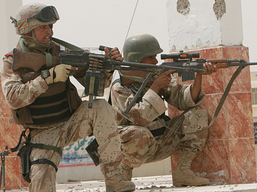
I just recently discussed how wrong it was to go into and stay in Iraq. Here is an opposing vision (which I continue to disagree with) by Fouad Ajami (friend of the Neo-Cons) from today’s Wall Street Journal: Continue reading
I just recently discussed how wrong it was to go into and stay in Iraq. Here is an opposing vision (which I continue to disagree with) by Fouad Ajami (friend of the Neo-Cons) from today’s Wall Street Journal: Continue reading
Filed under Essays

Since late February, it was fairly clear that Obama had clinched the Democratic nomination. Now that it is a reality for everyone (except maybe Hillary who has yet to concede). So what is Hillary waiting for? There is speculation that she wants the vice presidential slot or that she is looking for her supporters (and the Obama campaign) to help her with her debt.
Regardless of what she wants, what does Obama want? Should he offer the vice presidency to Hillary? Offering the ultimate olive branch to Hillary would theoretically help reunite the party and bring in all of her voters — especially female voters. But why should Obama be the one with the sole burden of offering olive branches and reuniting the party? Obama has been much more gracious than what the Clinton camp has admitted, and I doubt that any impartial observer would deny that Hillary has run a much nastier campaign, at times shockingly so.
But does Obama really need Hillary to win? Here are a few reasons why Obama should not choose Hillary as his running mate:
Last Tuesday, I went with my Swiss relative, Otto, to see the “Goya in Times of War” exhibit at the Prado Museum. The exhibition was incredibly moving in that it portrayed the entire range of Francisco de Goya as a painter and a human. While walking from painting to painting and room to room, you were witness to how the war in Spain had transformed Goya, consumed him, and tore him to pieces. You alternate between portraits of royalty and nobility to his “Disasters of War” depicting torture and other horrors of war suffered by an occupied civilian population.
Not only did Goya become one of the first ever photo-journalists, he also marked a very definite change in the role and purpose of the artist and his subject matter. Prior to the “Disasters of War”, scenes of war were almost exclusively glorious propaganda of military victory and accomplishment.
No matter how you look at the exhibit, you cannot deny that there is a timelessness about the commentary each sketch makes on occupation and suffering (I immediately think about the book I am presently reading on the Crusades), and there is a contemporary aura of protest. Some images look like they could have been snaps shots at Abu Ghraib, making us look and feel like something out of an unglorious past.
Then this morning, I watched the video podcast of The Bill Moyers Journal entitled “Body of War” discussing the upcoming film documentary of the same name by Ellen Shapiro and Phil Donahue about an injured American soldier who returns from Iraq. Now I do not have the bleedingest of hearts and am not 100% against war under all circumstances. But when faced with the basic facts and looking at how the war has destroyed American lives and families, not to mention how it has destroyed civilian life in Iraq (and the U.S.’s interests in the Middle East), there is no other choice than to be outraged.
And all of it happened under the willing eyes of our government (including Senators McCain, Clinton, and others) a permissive press, and a clueless populace. People should be hanging out more at museums.
Filed under Essays
Two Thursdays ago, I landed in Paris to find myself in the middle of the great French passtime: a public transportation strike. Luckily it wasn’t a complete shut-down, and there were still a few trains that I could take from the airport to the center of the city. While waiting for a train, I struck up a long conversation with a French gentleman, and as you could imagine (especially since the Bush years), I dreaded the question, “so where are you from?”
After deciding against the easy “Canada” cop-out, I came clean — “I am from the U.S.” The conversation turned almost immediately to the U.S. elections. What is so interesting about the presidential primaries this year is that they have very much impressed the rest of the world and helped restore the image of the U.S. abroad. As the gentelmen told me, “Over the last five months there has been a very clear move away from anti-Americanism in France. We are regaining our respect for your country.” Continue reading

Right now I am reading Amin Maalouf’s The Crusades Through Arab Eyes, and although I thought it would be more entertaining, it is slower moving and denser than I had anticipated. Nevertheless, it is still rather fascinating, especially when viewed in a contemporary context.
For example, there is an Arabic saying that goes something like, “Arabs only agree with other Arabs to disagree with each other”. From Maalouf’s accounts, you can see how much of the Crusaders’ success — given their numerical inferiority — had to do with the total lack of unity amongst the Arab rulers and peoples in the region. The Europeans further benefitted from the local rivalries by forming alliances, increasing the distrust between Arab rulers, and dividing and conquering. Does it sound familiar?
It is also interesting to read about the Crusaders’ brutality and how an early notion of jihad was born more from a political struggle of a people against ruthless (even at time cannibalistic) foreign invaders. In a similar vain, there is an op-ed in today’s New York Times precisely about the term jihad and its misuse by Western politicians and the media. Check it out: Continue reading
Filed under Essays, Literature

 Grave Error